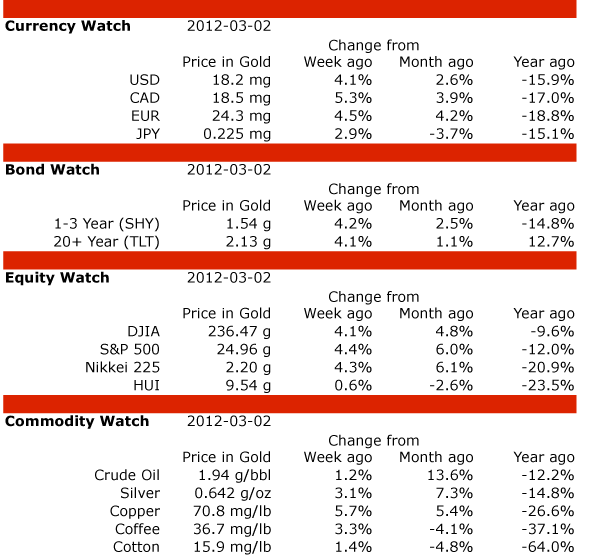
The last week has seen a series of new lows for the USD, ending at 19.42 mg on Friday. A lack of agreement on raising the US debt limit, terrorist attacks in Norway, and a massive 3 notch cut in Greece's credit rating by Moody's all contributed to an additional spike down over the weekend. The EUR also made new lows last week, as did the JPY. The CAD is hovering just above its all time lows, as well. All of these currencies are down strongly from a year ago, 25% for the USD, and about 17% for the others.

This is reflected in the value of bonds, as SHY closed the week at a new all-time low of 1.638 grams, down 1% from a week ago and down 24% from a year ago. 30 year bonds also set a new low last week, though they managed to recover a bit on Friday. TLT was down 1.1% for the week and down 26% from a year ago.

Equities were a bit higher for the week, with the DJIA up 0.7%, the S&P 500 up 1.2%, and the Nikkei 225 up 0.9%. US stocks were 8% lower and the Nikkei was 3.8% lower than one year ago. Gold stocks followed suit, rising 0.9% for the week; they remain down 3.8% from a year ago.

Commodities were mixed, with crude oil and silver higher, and copper, coffee and cotton lower. Crude rose 0.7% to 1.92 g/bbl and silver was 3% higher at 0.77 g/oz. Coffee was the biggest loser, dropping 5.3% for the week to 46.9 mg/lb; even so, it is still 11.8% higher than one year ago. Cotton lost 3.2% to 19.2 mg/lb, while copper fell 0.5% to close at 85.4 mg/lb.

With all the economic storm flags flying, I would suggest maintaining only small speculative positions in any of the major fiat currencies, and getting the bulk of your savings into the safety of gold – in your physical possession or as close to it as you can manage. While some would say that with gold at all-time highs this is a bad time to buy, I disagree. It would not surprise me to see gold prices lower in the next few months, but that simply argues for a small position in USD or EUR to take advantage of any such development. The risks of social, economic, political or military surprises is much too high to entrust the bulk of your assets to such risky positions. If you can't bring yourself to buy a large amount of gold at these prices, I urge you to buy smaller amounts regularly, regardless of price.

There is no way out for the USD and the other major fiat currencies. Debt levels are unsustainable, and the only politically acceptable solution is the subtle default of currency depreciation. Don't be trapped! Move your savings and cash balances to the safety of gold and your investments to things that can outpace the coming inflation.

Filed under monetary universe by  #

1

Today the USD hit a new all-time low of 20.02 mg. What more is there to say? Until real interest rates turn positive, or the US economy shows signs of real recovery, the appeal of the dollar is very limited. With the end of QE2 in sight, the Fed is faced with a tough dilemma: go for another round of money creation with QE3, or see the economy really start to fall apart around it. The true question is not "if" there will be more quantitative easing, but "how soon and how much".

And speaking of the US economy…

The Dow Jones Industrials, which closed today at 242.76, have retreated to their lowest level since March 20th, 2009, and now stand only 10% above their 2008/2009 financial crisis low of 220.22, set 10 trading days earlier on March 6th. Once that level is breached, prices will have rolled back to the level of January 1991, with the next support at about 200, and below that at 180 (which was the low for 1990 and the high just preceding the "Black Monday" crash of 1987. The S&P 500 shows almost exactly the same picture.

US Treasury bonds continue to fall, with SHY making a new all-time low in gold, and TLT just 2% above it's all-time low, even as they approach their old highs in dollar terms.

This week we've added coverage of natural gas to the site, another commodity sitting near it's all time lows. Home prices were also updated this week, and they are – surprise! – also making new lows.

Commodities were mostly lower last week, with crude oil, silver, copper, and coffee down, while cotton was up 5.4%. Commodity prices have risen significantly over the last year, however. Silver and coffee are up over 50%, cotton is up 63%, crude is 6% higher, and copper is 7.4% higher from one year ago.

The Canadian dollar is following close on its US cousin's heels, and the Euro and Yen, while they gained a bit last week, they are both down solidly over the last year. The Swiss franc is the one currency I track that seems to be holding it's own. Take a look at the currency charts for more.

Of course, if you own bonds, or large-cap stocks, real estate, or hold lots of currency (whether USD, CAD, EUR, or other), this sounds all sounds very depressing. But it is important to remember that it also means these things are ON SALE for those who do their saving in gold. They may get cheaper yet, so I'm not suggesting that you go "all in" at this point, but by following two simple rules, you will be ready to take full advantage when the time comes.

First, keep your "cash" and savings in gold, whether physical, in GoldMoney.com, in ETFs or closed-end funds (I use a combination of all of them for my own savings) and

Second, monitor your other investments' values in gold to be sure they're growing (and be ruthless about cutting your losses when they're not). If it isn't growing in gold value, you're better off just holding metal until you can find something that is growing. Don't forget that the USD and other currencies are potential speculations that make sense from time to time, but only hold them when they're appreciating in gold terms; at all other times, hold as little as possible.

Do these things, and you will find that the whole world will eventually be yours at fire-sale prices.

This is how great fortunes are made!

I've been studying the US Dollar lately… Looking at where it's been, and wondering where it may be headed in the future.

In February of 2001, the US Dollar would buy about 121 mg of gold. In March of 2011, it will buy about 22 mg of gold, a decline of 82%. This drop has been gradual, and the intervening years have been filled with the sell-offs and rallies that are common to all markets. This period has been characterized by massive and growing public and private debts, central bank manipulation to keep interest rates artificially low, and the creation of trillions of new dollars to keep the financial system liquid and stave off recognition of personal, corporate, municipal, state and federal bankruptcies.

But a closer look reveals that the decline has not been linear, but logarithmic – just like the decay rate of radioactive particles. Physicists refer to the rate of this decay as a "half-life"… Knowing this number lets them answer the question, "How long will it take for the radiation level to fall in half?"

In the case of a currency, how long does it take for its value to fall in half?

It turns out that over the last 10 years, the half-life of the US Dollar has been 4 years. In other words, every 48 months, the dollar loses half of its value! Here is a chart:
USD prediction chart
So unless something changes (for better or worse) we can expect that by the end of 2015, the dollar will be worth about 10 mg of gold (or put another way, that an ounce of gold will cost about $3,000). The key phrase is "unless something changes".

What could change? Invention of a new technology that could extract large quantities of gold cheaply, perhaps from sea water… Or a dramatic rise in real interest rates, the sort of thing engineered by Paul Volker to end the inflation of the 1970s. These things could push the relative value of the dollar up, and the price of gold down.

On the other hand, there could be a dawning realization that the dollar is doomed – that the US Government cannot possibly repay its obligations without simply creating the dollars to do so out of nothing – leading to a dollar collapse. If this happens, the dollar, like so many other fiat currencies before it, will have no value at all. Just like the previous US currencies, the Continental Dollar and the Confederate Dollar, or more recently, the Zimbabwe Dollar, it will become of historical interest only. In this case, it makes no sense to talk about a gold price at all… as the collapse gets underway, the price of gold will go higher and higher without any limit, until no cares about dollars any more. Those holding gold and other real assets will preserve their purchasing power, while those holding dollar-based financial assets such as bank accounts, CDs, T-bills, government and corporate bonds, and even most stocks, will be wiped out.

Psychologists often talk about normalcy bias, the tendency of people to assume that things in the future will be about the same as they have been recently. Usually, this works out fine; but from time to time, a "black swan" appears that causes things to change directions unexpectedly.

But what should we expect the dollar to do? Should we expect that next year its value will about the same as it has been recently? Or should we expect the decay of the last 10 years to continue? I think the latter is the most likely. And then there are the black swans, the things that are very hard to predict, but are always a possibility that must be considered and prepared for.

By monitoring prices in gold, keeping cash balances diversified in precious metals and multiple currencies, and by investing to grow your net worth in terms of gold, you will be well positioned for any eventuality. I am working now on some strategies to take advantage of the half-life of the dollar – let me know if you are interested in hearing more!

Filed under monetary universe by  #

The US Dollar traded in London at 21.67 mg on Tuesday afternoon, setting a new all-time low. Since the US Dollar was created by congress in 1790, with a value of 1600 mg of gold, it has lost 98.6% of its original purchasing power, leaving only 1.4% between here and total worthlessness!

The Japanese Yen also made a new low of 0.265 mg. The Canadian dollar traded at 22.24 mg, off slightly for the day, but 2% higher than its all-time low set last December. The Euro, at 29.91 mg, fell for the fourth trading session in a row, but still sits 3.4% above its all-time low.

The value of US Treasury Bonds fell sharply, with the both Exchange Traded Funds SHY (tracking 1-3 Year Treasuries) and TLT (tracking 20+ Year Treasuries) hitting new all-time lows of 1.817 mg and 1.971 mg, respectively.

The Dow Jones Industrials closed at 261.46, down almost 1% for the day, but still up 3.4% for the year to date.

Crude Oil is trading at 2.18 grams/barrel, up from a recent low of 1.91 g/bbl in mid-February, but still below it's 60 year average of 2.31 g/bbl. Silver, on the other hand, continues its surge skyward, hitting 0.753 grams per ounce – up 11.5% so far this year, following a rise of 41.1% in 2010. The last time silver was this high was February of 1998, when it traded over 0.8 g/oz. Even with this recent strength though, silver is a long way from its 1980 all-time high of 2.8 g/oz.

Don't let the constant barrage of rising prices quoted in fiat currencies confuse you! Remember that these are largely caused by government and central bank shenanigans of one sort or another. Keep your eyes on the true value of things by pricing them in gold, and seek out investments that will grow when measured in gold terms. That's what you need to build a better life for yourself and your loved ones!

With fiat currencies all over the world being manipulated by central banks, prices are being distorted beyond all recognition. Successful investing requires having a good idea what things cost, and what they are really worth – and using the world's oldest and most stable form of money, gold, to compare prices is one way to get that insight. Below you'll find a sample of prices measured in grams or milligrams (1/1000 of a gram) of gold.

Currency Watch:

Change from
Price in Gold Week ago Year ago
USD 22.5 mg -1.4% -19.2%
CAD 22.8 mg -0.4% -14.2%
EUR 30.6 mg -1.0% -19.0%
JPY 0.270 mg -1.2% -11.7%

After revisiting its all-time low of 21.89 mg on January 3rd, the USD rallied during January, peaking at 23.58 on January 28th, up 7.7%. Since then, it has been drifting lower, and currently stands 2.7% above the all-time low. A similar pattern exists for most other major currencies, though the Yen and Canadian dollar have lost less ground in the past year than the US Dollar and Euro. [Washington's Birthday update: as of 21-Feb-2011, the USD stands at 22.17 mg, only 1.3% above it's all time low.]

Bond Watch:

Change from
Price in Gold Week ago Year ago
1-3 Year (SHY) 1.88 g -1.2% -18.2%
20+ Year (TLT) 2.01 g -1.4% -15.4%

US Treasuries have been a terrible investment for at least the last 8 years. Since 2002, shares of SHY, an ETF that tracks the 1-3 Year maturity T-Bonds, have lost 74% of their value, despite an apparent increase of 28% when measured using dollars – and these figures include interest paid! The long bond, as measured by the share price of TLT, is just as bad, having lost 69% of its value since 2002, despite a smoke-and-mirrors “gain” of 56% when measured in dollars. And as we'll see in a moment, these losses are not simply due to a “gold bubble”. Priced using dollars, most things you buy every day have increased in price dramatically since 2002 – gasoline has more than doubled, food prices are 2.6 times higher, cotton prices are over 4 times higher! The lion's share of these increases are caused by dollar depreciation. And keep in mind that the so-called gains are taxable… while the real-world losses are not deductible. The government takes your money at full value, repays you with currency that will buy much less, and taxes you on the difference – all part of the miracle of inflation!

Equity Watch:

Change from
Price in Gold Week ago Year ago
DJIA 278.58 g -0.5% -3.7%
S&P 500 30.19 g -0.4% -1.9%
Nikkei 225 2.93 g -0.6% -7.4%
HUI 12.46 g +4.3% +7.9%

Major stock indices have been falling for the last 10 years. The Dow Jones Industrials, for instance, hit its all-time high around 1,400 gold grams in 1999. It has since lost over 78% of its value. For the last two years, major indices have been pretty flat after bouncing off the lows set in March of 2009. As with bonds, nominal prices have risen as currency values have fallen, leaving investors with purchasing power losses and huge tax liabilities. One area that has bucked this trend is resource stocks – a specialty of my friends at Casey Research. Selected issues have soared, and even the broad resource indices like the HUI show real gains over the last year.

Commodity Watch:

Change from
Price in Gold Week ago Year ago
Crude Oil 1.91 g/bbl -2.1% -13.1%
Uranium 1.62 g/lb -2.4% +40.7%
Silver 0.718 g/oz +5.0% +63.0%
Copper 99.9 mg/lb -2.2% +11.8%
Coffee 61.1 mg/lb +6.3% +63.7%
Cotton 44.3 mg/lb +2.2% +106.8%

Each of these commodities has its own story to tell… tales of weather (good and bad), of mine cave-ins, political instability and bureaucratic stupidity.

Silver is skyrocketing, not just in dollars, but in gold value as well, having closed convincingly above its long term resistance level at 0.7 grams of gold. It will be interesting to see that level retested in the weeks to come. If it holds, the 1.0 gram level, last seen in the early 1980s, could be the next stop.

While it is clear that the trend is mostly up, what is not so clear in the numbers above is the bigger picture – that most of these commodities are rebounding off their all-time lows.

Crude Oil, for example, finds its long-term support at around 1 gram per barrel, and hit 1.1 grams two years ago in February of 2009. Although it has recovered to almost 2 grams, crude traded over 4.9 grams per barrel as recently as 2008. Coffee is another example – in May of 2010, it traded under 34 mg per pound. Although it stands today at 61.1 mg, in 1997 it traded over 230 mg/lb (and at a dollar price very similar to today's, highlighting the massive depreciation of the dollar.) Cotton has really been on a tear (pardon the pun) gaining another 2.2% this week following a 12.4% rise last week, and more than doubling in the last year. But these gains are coming off record lows of less than 20 mg/lb in early 2010. Cotton's 30 year average price is 53.2 mg (20% higher) and its record high of 250 mg is more than 5 times today's levels.

Chart of the Week

Chart of food prices in gold
This chart was inspired by the events in Egypt and elsewhere in the developing world, where concerns over food price rises are playing a major role in people's dissatisfaction with government. As one who is profoundly dissatisfied with all governments, I think this may be a good thing. But what is really going on here? When you strip away the veneer of currency depreciation, we see that food prices are actually near their 20-year lows, not making new highs!

In fact, the overall food price index would have to rise 72% from today's levels just to get back to its 20 year average. The Meat component would have to rise over 140% to get in line with its average. And even Sugar, the fastest rising component, would need to rise a further 20% just to revert to the mean.

The real problem here is that governments are destroying the purchasing power of money – your money – even while technology and intelligent employment of capital are reducing the costs of food, technology, energy, housing and transportation. Unfortunately, governments are kleptomaniacs. They corral your money with capital controls, then steal it openly by raising taxes in the form of new regulations, closed loopholes and higher rates; and stealthily, through currency destruction and the taxes collected on the resulting pseudo-gains. This has left most households with less disposable income than they had in 1950 – requiring them to work two or more jobs just to make ends meet!

But that's a story for another edition…

In the meantime, don't be fooled by bogus government currency shenanigans! Keep track of your investments' true value, using gold.

Sir Charles

The other day, I was writing an email to a friend and the following rant somehow slipped in. After re-reading it, I decided to post it here, and expand on it in the coming days.

Ultimately, this is all about freedom… The more I work out the implications of "gold thinking" and try to free my mind from the mesmerizing influence of fiat currencies, the more I realize that it isn't just the money, but the freedom to conduct my business and my life the way I want to that is at stake here. It seems to me that most people start by moving some assets offshore, then a few of those go further and move themselves offshore, but very few actually go so far as to move their minds offshore! And a big part of this is the constant drumming of the fiat currency message that bombards us from all directions. From the media to the gas station to the grocery store to the bills we get every day in the mail, not only is the world drowning in dollars, but our minds are drowning in dollar prices! It is a powerful hypnotic drone that keeps us in thrall to our monetary overlords, regardless of where we do our banking, set up our businesses, or make our homes.

At the Casey Conference in San Diego, Richard Russell told a story about his wife, and her preference for dollars, versus his preference for gold. He referred to his wife as a "Dollar Bug". She's not alone: there are millions of times more Dollar Bugs in the world than there are Gold Bugs or Silver Bugs, and the Dollar Bugs are far more rabid than even the most outspoken Gold Bugs. Perhaps "Dollar Zombie" would be a better term… Zombie banks aren't the worst of it: we are living through the Dollar Zombie Apocalypse, right now!

Next time, I'll look at some ways of fighting back against the Dollar Zombie menace. Until then, keep your profits growing, in gold!

Filed under monetary universe by  #

Kenneth wrote in with the following excellent questions:

Hi Charles,

Thanks for your great insight. I have been planning to buy gold and silver early next year and I just have 2 questions.

1. Why is gold priced in US dollars and what are the chances that gold will be priced in euros or yuan when the dollar collapses?
2. Should I stock up on silver or gold?

Thank you in advance,
Kenneth

PS: Great website by the way.

Hi Kenneth,

Thanks for the kind words!

Regarding your questions, 1) gold is already priced in several currencies – the London Bullion Market Association, which publishes the London AM and PM fixes, does so in USD, GBP and EUR each day (updated twice a day). The World Gold Council publishes daily prices in 15 currencies, updated weekly. I think that the USD price is the most widely reported number, but certainly not the only one available.

As to whether the USD or the EUR will be the first to collapse, that's anyone's guess! All the world's fiat currencies are in a race to the bottom… that's why your second question is so important! And my answer to 2) is YES! The real questions are, how much, and in what form.

I see physical gold as the best form of cash. Gold is not an investment. It will never make you rich, it just sits there. It doesn't grow, it doesn't pay interest or dividends, it doesn't make anything, or improve the world in any way. It is just some lumps of metal. BUT: It is not anyone's liability. There is no counter-party risk. No bank failure or currency crisis can cause it to disappear. No government can inflate its value away. Your only risk is physical theft. Thousands of years of experience shows it will keep it's value while other forms of money come and go. So while gold cannot make you rich, it can keep you from becoming poor!

By physical gold, I mean coins, bars, and other forms of the metal that you have direct custody of, stored in a safe place you have direct access to and control over. Once you give it to someone else to take care of for you, you begin to lose the essential protection of gold, because you now have a partner you have to trust to give your gold back when you need it. This applies to bank safety deposit boxes, gold certificates, and other storage programs. The reason to take on this risk is convenience and efficiency of transactions, and to mitigate the risk of physical theft. You have to judge that trade-off for yourself. My suggestion is to diversify your holdings so that if one approach fails, you have not lost everything.

Other forms of gold ownership, such as ETFs like GLD, closed end funds like PHYS and CEF, and so on, are really stocks that should hold their value in terms of gold, and can be used as a holding account for money that is awaiting investment elsewhere, rather like money market funds. But they are not cash, and may not be good vehicles for long term savings, as they carry lots of counter-party risks.

How much gold to own is also something you need to decide for yourself. How much cash do you feel comfortable holding? The more you have, the safer you are if there is a crash or other financial disaster, but the less you have at work growing for you. If you are confident about the future, hold very little gold, and invest the rest in stocks, businesses, real estate, and other opportunities that will be worth more and more gold every passing year. If you are worried about the future, hold lots of gold, and invest only what you can afford to lose.

Silver, which has extensive industrial uses but very little monetary use at the moment, is more of an investment – it can gain or lose value relative to gold. I see it as a speculation, but one that is much less risky than the USD or other fiat currencies. It shares many of gold's desirable characteristics, so it makes sense to include it in a diversified plan. Keep in mind that it is much bulkier than gold, and has much higher storage costs. But this bulk also means that silver coins could be useful for small transactions where no gold coin is small enough. And don't forget that while it can rise in gold value, as it has for the last few months, it can also fall in gold value – sometimes a lot.

I hope this is helpful. Keep those questions coming, and keep your wealth growing, as measured in gold!

Cheers,

Sir Charles

Many of my favorite stocks are Canadian. Part of this comes from a natural resource bias which tends to hold it's value in inflationary periods, and part from the CAD itself, which has recently benefited from a resource-based economy and somewhat less profligate than usual fiscal policies.

Andrew recently commented on the Dow Jones Industrials page that he'd like to see a chart of Toronto Stocks priced in gold, and I thought that was a great idea.

Toronto stocks are somewhat more volatile than the S&P 500, but this can be a good thing, creating tradable bull markets that allow for a positive return in gold terms. The period from 2003 to 2007 was one example. While the S&P 500 fell 15%, the TSX rose by 72%. Even with that bull market though, a buy and hold strategy, while beating the S&P 500 since 2000, would have lost over 50% of your gold invested. Most investors are blissfully unaware of this loss, since over the same period, the TSX has risen more than 50% when measured in Canadian Dollars.

So the key is to be in the right stocks, at the right times – and to track your performance in gold, so you'll know when to buy and when to sell, to keep your wealth growing in gold terms.
Chart of the TSX from 2000 to present

Filed under Stocks by  #

Bloomberg News and Priced in Gold

Nov. 6 (Bloomberg and Priced in Gold) — Warren Buffett’s Berkshire Hathaway Inc., holder of a derivatives portfolio worth more than 1.3 billion gold grams, said third-quarter profit declined 29.7% percent on losses tied to equity-linked contracts and the falling value of the US Dollar.

Net income fell to 71.1 tonnes, or 43.17g per share, from 101.1 tonnes, or 65.2g per share, a year earlier, Omaha, Nebraska-based Berkshire said yesterday in a statement. Operating earnings, which exclude some investment results, were 40.27g a share, missing the 41.3g average estimate of five analysts surveyed by Bloomberg.

Berkshire posted a 3.47 tonne derivatives loss, compared with a gain of 54.1 tonnes in last year’s third quarter. Buffett, 80, seeks to add to earnings from Berkshire’s insurance, energy and consumer-goods units by placing derivative bets on equity indexes and the solvency of borrowers. The equity-related contracts produced a 16.7 tonne loss and were driven down by a weaker U.S. dollar, Berkshire said.

“I’m sure Warren Buffett’s appetite for derivatives is less than it was,” said Michael Yoshikami, who oversees a portfolio worth about 22 tonnes of gold, including Berkshire shares, at YCMNet Advisors in Walnut Creek, California. The loss “suggests the danger of derivative contracts in the first place, which probably will limit the number of derivative bets they make in the future.”

Credit-default swaps, derivatives in which Buffett bets on the solvency of borrowers, gained 12.4 tonnes in the third quarter after posting a 45 tonne profit a year earlier. The loss on equity-related contracts compared with a 6.9 tonne gain in the third quarter of 2009.

Book Value

Book value, a measure of assets minus liabilities, fell 11.5 percent in the quarter to 3.56 tonnes from 4.02 tonnes on June 30 as the falling value of the US Dollar eroded capital.

Berkshire's long position in the US Dollar stood at $34.5 million, worth 820 kg of gold as of Sept. 30, compared with $28 million worth 790 kg three months earlier. The stock portfolio was valued at 1,370 kg at the end of the third quarter, down 11% from 1,540 kg on June 30.

Berkshire fell 5.06 grams to 2,798.53g in New York Stock Exchange trading yesterday and has fallen about 10 percent this year. The Standard & Poor’s 500 Index, which rose 5.4 percent in the third quarter, has lost 13 percent this year.

Despite the deterioration of the company's position, management took an up-beat attitude: “Operating results for many of our manufacturing, service and retailing businesses improved versus 2009, reflecting some stabilization of economic conditions,” Berkshire said in a filing. “We are hopeful that recent economic improvements will continue over the remainder of 2010 and beyond.”

Berkshire, which employs more than 200,000 people, cut about 20,000 jobs last year.

To contact the Bloomberg reporter on this story: Andrew Frye in New York at afrye@bloomberg.net .
To contact the Bloomberg editor responsible for this story: Dan Kraut at dkraut2@bloomberg.net .
To contact the Priced in Gold editor responsible for this story: Charles Vollum at editor@pricedingold.com .
To read the original Bloomberg story, click here.

Berkshire Hathaway Price Chart

Chart of Berkshire Hathaway shares, in gold grams

The last time we talked about the Dow Jones Industrials "breaking through" the 11,000 level was back in April. After spending about 15 days above the 11,000 mark, the Dow sank back below 10,000 in June, and again in July, after which it began working higher, bringing us to 11,006 on Friday, a level which just barely held in Monday's trading, closing at 11,010.

So as the song says, are happy days here again? With all the talk of QE2, of inflation being too low for the Fed's liking, and their stated willingness to "do whatever it takes" to fix up the economy, it's hard to know what the USD price of anything means any more! Let's see what the Dow priced in gold is telling us.

Back in April, I pointed out that the Dow price of 300 grams of gold was about where it had been since the start of 2009, pretty much a flat-line, aside from a brief excursion down to 220 in March of 2009. Since then, the Dow has been working its way lower, and now sits at 253.4 grams, about 14% lower than the last time it traded above 11,000 in USD. As the chart below shows, the recovery of stock prices (as measured in USD) is an purely an illusion.

DIA ETF in gold and USD/10

The US Dollar itself is losing value about as rapidly as stocks and other assets are being inflated. In fact, the specter of rising taxes, increasing regulation, and the uncertainty of what crazy bailout, stimulus or pork-barrel program will be announced next has investors working their way to the exits.

That's something to keep in mind when reading the financial news priced in fiat currency! Don't let it ruin your investments. There are things that are rising in gold terms. That's where you want to be invested.