1

Anxiety over the massive coordinated money printing program continued this week, pushing the EUR and CHF to new all-time lows and the USD to the lowest level since February. For the week, though, the JPY dropped more than either the USD or EUR, losing 1.3% to close at 0.223 mg.

Cotton also continued to drop, hitting another new all-time low of 12.5 mg/lb, down 5%.  But the weakest asset of all was Crude Oil, down 6.6% to close the week at 1.62 g/bbl.

Paradoxically, TLT, representing the long term US treasuries, was the strongest performer for the week, up 2.2% to 2.12 g.  The only other gainer was the HUI gold stock index, which rose 1%.

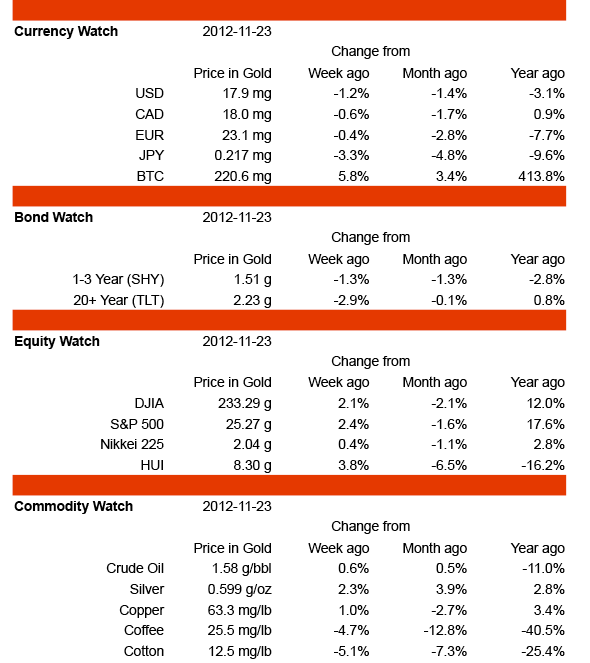
Table of prices in gold for week ending 9/21/2012

Filed under monetary universe by  #

0

This week saw massive coordinated central bank "easing", aka money printing, with the ECB promising unlimited new bond purchases to bail out the Eurozone and the German high court giving it's go-ahead, with the result that the EUR dropped to new all-time lows before experiencing a little "shadenfruede recovery" on the Fed's announcement and closing the week down 0.3%.

Not to be outdone by the ECB, the Federal Reserve announced QE3, an open-ended one-two punch of zero interest rates and $40 billion in new money every month with no end date.  As the saying goes, "the beatings will continue until morale improves". Morale certainly took a nose dive on the news, with the long bonds as represented by TLT dropping a whopping 7.2% for the week, punching dramatically down through the lower edge of the trading channel, and erasing most of TLT's gains for the last year. And this drop occurred on massive volume – look out below! The USD itself dropped by 2.7% to close at 17.5mg,  down 11.3% for the year to date.

Cotton also took the news badly, falling to a new all-time low of 13.0 mg/lb before ending the week at 13.2 mg, down 3.1%.

While currencies and bonds were markedly lower, stocks were mixed.  The big US indices are slightly lower (S&P 500 down 0.8%), but the Nikkei 225 rose 1.7%, and the HUI gold stocks rose 4.2%.

The week's strongest performer was coffee, rising 8.2%, to close at 31.7 mg/lb.  Silver was in second place with a 4.8% gain. The charts for silver, platinum, coffee and the HUI are all starting to look like they may have found their bottoms, but they have yet to break out above their overhead resistance levels.  Keep an eye on these going forward.

I've spent the last few days in London for the 2012 Bitcoin Conference. It has been extremely interesting and educational. There is an incredible spectrum of political opinion, ranging from radical crypto-anarchists to utopians (the abolition of the need for money as costs of living approach zero) to minarchists to outright communists.  The debates and Q&A sessions are colorful and informative, but well-mannered and respectful of other's positions.

There were some great presentations on legal and legislative issues and how these are likely to evolve over time. Also a very important presentation on the potential for non-monetary applications of the bitcoin protocols: smart contracts, smart property, and other interesting concepts that are in there, but not used at all so far (stuff that could come into play a few years down the road when the currency aspect is soundly in place.)

I had a chance to talk with some of the people maintaining and developing the bitcoin software, as well as people developing applications and businesses around the new currency. I was very impressed with the systematic approach being taken to keeping the currency system robust and scalable, so that it can continue to grow as more and more users discover what it can do for them.

Many of the sessions were recorded, and if they are made available, I'll post a link here. Meanwhile, if you'd like to see the slides for my presentation, drop me an email, and I'll be happy to send you a copy.

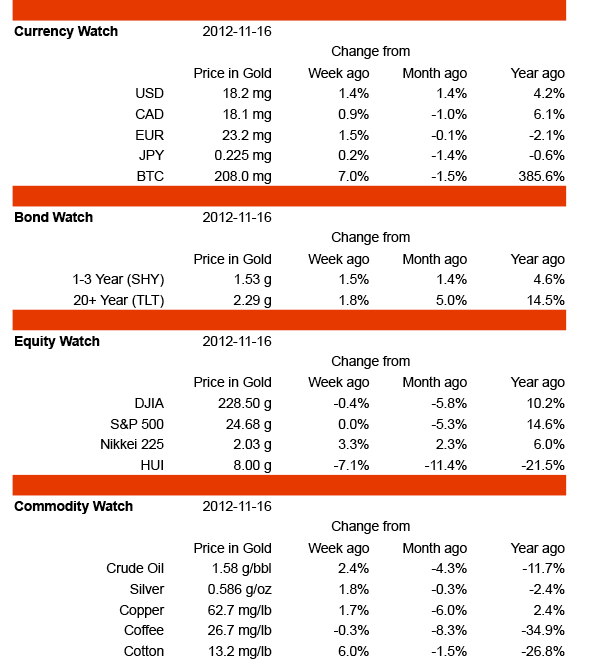
Table of prices in gold for week ending 9/14/2012

1

This was a bad week for most investments, with announcements of QE in Europe, and hints and rumors of QE from the Fed pushing down all the major currencies, and hurting most of the investments denominated in them.

The biggest loser was TLT, our proxy for long tern treasury bonds, off 7.2%. See the chart and more comments on TLT below.  Although the EUR fell less this week than the other currencies, it ended the week at a new all-time low of 22.7 mg.  The EUR is now down about 11% so far in 2012.

The biggest winner was silver, which rose 0.7%.  The only other gainers were the HUI gold stocks, up 0.6%, and copper, which added 0.5%.

US stocks, while down for the week, fell less than the currencies, bonds, or the commodities (ex silver and copper). They are now the best performing asset class in our chart over the last 12 months, with the S&P up 25.7%.

Platinum, after making a new low on August 13th, has gradually recovered by about 7%, but is still trading at a 7% discount to gold, presenting a good buying opportunity.

In my Aug-17 Market Update, I indicated that TLT was at a critical point, trading near the lower edge of its channel, and near its 200 day moving average. Over the last year, whenever TLT reached these levels, buyers stepped in and pushed the price up. This doesn't seem to be happening this time around, however. After struggling to rise 2.9% at the end of August, TLT has since dropped 8%, and now sits 2.3% below its 200 day average. It will be interesting to see how the Fed responds in its upcoming FOMC announcement. They are in a tough spot, however, as any new money that is used to push rates down will also depress the value of the USD.

Long Term Treasury Bonds from 2008 to Present

New this week to Priced in Gold is coverage of Bitcoin, a digital currency that has been circulating for the last two years.  Rather than relying on a central bank to control its issuance, and government law enforcement to prevent counterfeiting and fraudulent transactions (actually to prevent any type of transactions the government frowns upon), bitcoin uses the internet and cryptographic techniques to allow anyone, anywhere in the world, to accept, originate and verify transfers – for free. Already there are many exchanges where bitcoins are bought and sold for national currencies, and web merchants are starting to adopt bitcoin as a means of payment. Bitcoin stock exchanges, auction sites, and other marketplaces are springing up all over the internet.

How do gold coins and bitcoins "stack up"? Will bitcoins replace gold coins? Is bitcoin a flash-in-the-pan that will disappear even more quickly than it came on the scene? Will governments allow bitcoin to exist alongside their currencies? Do they have any choice? Should you get started with bitcoin now, or wait until it has more of a proven track record?  I will be speaking about these topics at the London Bitcoin 2012 Conference.  If there are any subscribers in the area, I'd love to meet you – please drop me an email, and we'll work out a time to get together.


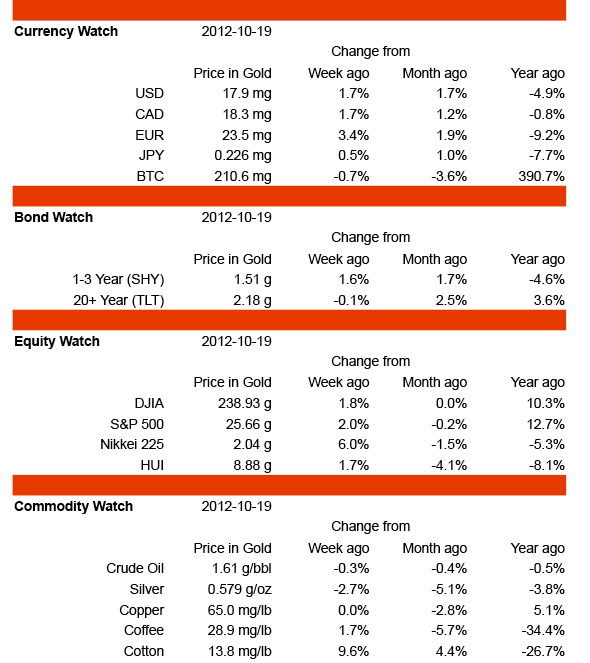
Table of prices in gold for week ending 9/7/2012

4
Another great email just came in, asking for a chart of the US Federal Debt.  I'm not sure what the US Debt numbers really mean… the data are so manipulated and massaged, and they leave out so much (state and local government debt, unfunded liabilities, and on and on)… but here is a stab at it.
 
This chart uses US Federal Debt data from US Federal Debt United States 1900-2016 – Federal State Local Data.  The gold prices used for conversion are annual averages for 1900 to 2011, and for 2012 to 2016 they are estimates based on my Half-Life of the USD curve.

 
Over the last decade, the government has inflated away more than half of the peak federal debt.  It is now back to late 1960s levels; if we continue to halve the debt every decade, it could be back to 1930s levels by the 2030s.  Of course, by that time, gold will be over $45,000/oz, gas will be $120/gal, a first class stamp will cost $13 (if the USPS is still in business – not likely!), and a McDonald's Happy Meal will probably set you back $90.
 
I find it sort of refreshing to see that the debt is being reduced in real terms in spite of its phenomenal growth in nominal terms; but the economic implications of this "inflationary depression" are downright scary.  The mis-allocations of capital caused by these policies will be horrendous, resulting in dramatically lower standards of living for the average family.  I wonder if they can really keep it up for two more decades before people catch on to what's happening? We'll see!
 
Cheers,
 
Sir Charles
Editor@pricedingold.com
 

Filed under monetary universe by  #

0

I got a great question in my email this morning, and I'd like to share it, and my answer, with you.

Using your methods, how can one know when gold and silver are grossly overvalued? Much like the tech stocks around 2000-2001?
 
I don't think of it in quite those terms… I use gold as the unit of measure, and thus see it as unchanging.  The USD may rise and fall, silver may rise and fall, but gold is my constant, like cash.
 
If you put 1kg of gold in a safe for 10 years (or 100 years!), you will still have 1kg of gold.  No gain, no loss. Put enough $100 bills to buy 1kg of gold in the same safe, and you will probably not be able to buy anything close to the same amount of stuff with it in 10 or 100 years (if the bits of paper have any value at all!)
 
So taking the US Dollar first, your question would be translated as "how can one know when the dollar is grossly overvalued, much like the tech stocks in 2000-2001?"  If that time comes again, you will want to sell your dollars and go to cash (gold), just as in 2000-2001.  Conversely, we could get a bottom in the USD, as in 1980, and it might become a good long-term speculation.  I don't think that is anywhere close yet.  And there is a real possibility that the USD will continue to fall gradually for a long time, or suddenly fall a lot, or even be replaced by some other monetary unit leading to a near-zero value… so I see buying dollars as a risky speculation, but one that could be quite profitable from time to time – as indeed it has been for the last 12 months or so.
 
My favorite tool is the "half-life of the dollar chart".  When I see the USD moving below the half-life curve significantly, say by 10%, I start paying attention. If it starts to recover, you could be entering a period of mean reversion that would make the USD a good buy.  The main fundamental that is likely to drive the USD up would be positive and rising real rates of interest.  When the bond vigilantes ride again, it might also be time to buy USD, at least for a medium term speculation. As long as the Fed is holding interest rates low, and concern about the economy and deflation is strong, I think you are better off in cash (gold), since the Fed will be using various tricks to increase the money supply to fight these perceived threats.
 
Silver is a different animal; I see silver as primarily an industrial metal, with a secondary monetary appeal to smaller savers.  As such, it is quite volatile, but unlike the USD, will never be without value – and is thus a less risky speculation than the dollar.  My suspicion is that either the economy will need to improve dramatically, or the USD will need to tank, for silver to show real strength.
 
I hope this is helpful!
 
Cheers,
 
Sir Charles
1

Today, Apple Computer (AAPL) became the company with the highest market capitalization ever, as measured in US Dollars. It exceeded the market cap record set back at the end of 1999 by Microsoft, according to the MarketWatch article "Apple closes as most valuable company of all time".

But a USD today doesn't buy what it used to in 1999.  In fact, a dollar on 27-Dec-1999 (the day of Microsoft's all time high price of 6 grams per share) would buy about 108 mg of gold; today, a dollar will buy just over 19 mg of gold.  So according to the figures quoted in the article, MiSFT's all time high market cap was 66,397 tonnes of gold, while AAPL's market value today was just 12,008 tonnes – less than one-fifth of MSFT's at its peak.

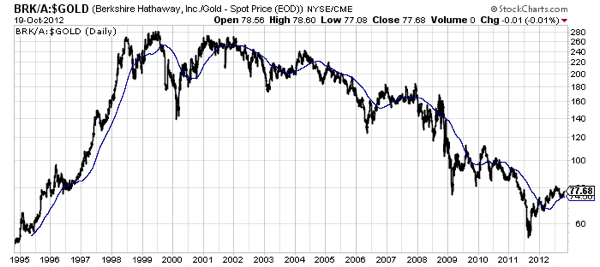
Check out these charts (courtesy of StockCharts.com, prices in ounces of gold). Apple stock has risen a lot since 1999, while Microsoft has fallen; but Apple still has a long way to go before it truly exceeds MSFT's all time value record.

Filed under monetary universe by  #

0

As usual, the biggest gains and losses were in the commodities this week, with crude oil rising 3.6% while coffee fell 3.4%.  Silver and copper also gained, while cotton was off slightly.  The currencies were little changed, with the Canadian Dollar up 0.7%, the USD up 0.2%, the Euro unchanged, and the JPY down 0.6%.

Equities were higher this week, lead by the Japanese Nikkei Index which rose 2.4% despite the headwind of a falling currency unit.  Gold stocks and US equities also gained for the week.

Platinum made another new low on Monday, but rose through the week to finish at 28 mg/oz, up 4.2%.  There is no way to know if the bottom is now in, but it is rare to see platinum trading at a discount to gold; this is a great buying opportunity.

Although short term treasury bonds rose 0.2% (exactly in line with the US Dollar), long term bonds have been falling fast, racking up another 3% decline this week alone.  They are now approaching the lower edge of the channel they have been trading in for the last year.  This channel edge is also very close to the 200 day moving average, which should lend further support.  If this support holds, look for a retest of resistance at 2.6mg; if support fails, look out below!

Long Term Treasury Bonds from 2008 to Present


Table of prices in gold for week ending 8/17/2012

Filed under monetary universe by  #

0

Last week saw yet another reversal from the week before; once again, the only thing in common was the continuing decline in silver and copper, now in its 3rd week.

Currencies gained back some of what they lost the week before, lead by the CAD, which rose 1.8%. Bonds were higher, the SHY up 1% (in line with the USD) and the long term TLT up 0.4%, only recovering a tiny portion of the prior week's 3.8% loss.

Equities were all higher except for the gold stocks represented by the HUI, which fell by 0.1%.  The Dow and S&P 500 rose1.2% and 1.4% respectively, more than offsetting the prior week's losses.

Commodities were mostly higher, lead by crude oil, up 2.4%, followed by coffee and cotton, up 1.1% and 0.9%. Silver and copper were lower by 0.7% and 0.9%.

Platinum, which I don't usually include in these weekly summaries, made a new 12 year low on Friday. The "other white metal" is now 13.23% cheaper than gold at 27 grams per ounce.  I continue to expect that platinum will eventually trade for more than gold, as it has for most of it's history, but fears of recession in the US and Europe, along with slowing growth in China, appear to be pushing industrial metals like silver, copper and platinum lower in the short term. I see this as a buying opportunity.

Platinum from 2000 to Present


Table of prices in gold for week ending 8/3/2012

0

Last week was almost a complete reversal from the week before; the only thing in common was the continuing decline in silver and copper.  

Currencies were all down strongly, with the EUR leading the decline, falling 3.2%. Bonds also fell; the long term TLT falling the most, down 3.8% while the shorter term SHY moved down 2.6%, roughly in line with the decline of the USD.

Commodities were all lower, lead by coffee, down 9.5%.  Silver showed the least weakness, falling only 0.2%.

The main stock indices also declined, lead by the Nikkei, down 2.8%; gold stocks bucked the trend, with the HUI rising 0.6%. The Dow, although down 0.7% this week, is still near it's high for the last 12 months (set last week). The 250 gram level was support during 2010 and the first half of 2011; in 2012 it has become resistance. It will be interesting to see if stocks can break out above this level; if not, a retest of last fall's lows may be in order.

Dow Jones Industrials from 2006 to Present

The USD continues to to stick very close to its "Half Life Curve", losing about half of its value every four years. For the last month, it has been hovering about 5% above the curve. After several years of under-performance, it would be entirely reasonable to see continued out-performance and some further gains. Continuing crisis in Europe, slowing growth in China, and recession concerns in the US provide ample fuel for this. On the other hand, these same trends make money printing, quantitative easing, plunge protection, and other central bank hanky-panky all the more likely; this means that any USD upside will likely be short lived.

USD Half Life Curve

If you are lucky enough to live in Switzerland, have a happy Confederation Day!

Table of prices in gold for week ending 7/27/2012

Filed under monetary universe by  #

0

Last week showed many gains and few losses.  Once again commodities lead the way, with crude oil up 6.7% and coffee up 2.6%.  Silver and copper were each down 0.3% – the largest losses for the week.  Gold and silver mining stocks also suffered, falling 0.2% for the week.

Currencies were all up, with the Canadian Dollar performing best, up 2.1%, followed by the JPY up 1.8% and the EUR, up 1.7%.  Although the CAD and EUR did well this week, they are both down from a year ago; the USD and JPY are up slightly over that time period.

Bonds and major stock indexes also rose, with the long treasuries up 1.9% and the S&P 500 up 1.7%.  TLT, the long treasury ETF, remains in the resistance zone between 2.5 and 2.6 grams.  I am currently out of this position, waiting to see if it will break above or below.  Still, TLT is the only security tracked here that is up strongly over the last year (up 41.2%).  It remains to be seen if there is more upside to these long bonds.  Eventually, short TLT and long HUI will be a great trade, but how soon?

Table of prices in gold for week ending 7/20/2012