0

We made it safely around Cape Hatteras (aka "The Graveyard of the Atlantic") and have arrived in North Carolina. I will be off the boat for Thanksgiving, continuing the trip south in couple of weeks.  A full set of chart updates is now online.  Thanks for your patience!

****

Updates may be a little late this week, as I am underway sailing from CT to FL. Keep an eye on Uranium, which is now at it's lowest price since 1994, and Coffee, which has continued to make a series of new lows this week.

When I get to port, I'll post a full set of updates.

Cheers,

Sir Charles

Filed under Coffee, Uranium by  #

0

This was a good week for most investments, with all the currencies and bonds higher, all equities except gold stocks higher, and commodities mixed.

Bitcoin was the strongest currency, gaining 4.5% for the week, but this represents a recovery of less than half of last week's loss.  The Japanese Yen was the best performing government currency, rising 1.9%, closely followed by the USD and EUR.  Even the Canadian Dollar, the weakest of the bunch, rose 1.2%.

Bond values rose, but the short term treasuries outperformed the longer dated issues as SHY climbed 1.9% while TLT gained only 1.5%.

Conventional equities were all up, led by the Nikkei Index.  Bolstered by the strong performance of the JPY, the Nikkei gained 3.3% to close at 2.09g.  The S&P 500 rose 2% to close at 26.10g. Only the gold stocks declined, with the HUI Gold Bugs Index losing 1.6% to close at 8.76g.

Commodities were mixed, with silver and crude oil higher by 2.6% and 1.1% respectively, while copper, coffee and cotton traded lower. Although cotton dropped more than any other commodity for the week (down 1.1%) coffee's decline was more significant, setting a new all-time low of 27.81g on Thursday before recovering to close at 28.56g, down 0.1% for the week.

Bitcoin priced in gold

Coffee priced in gold

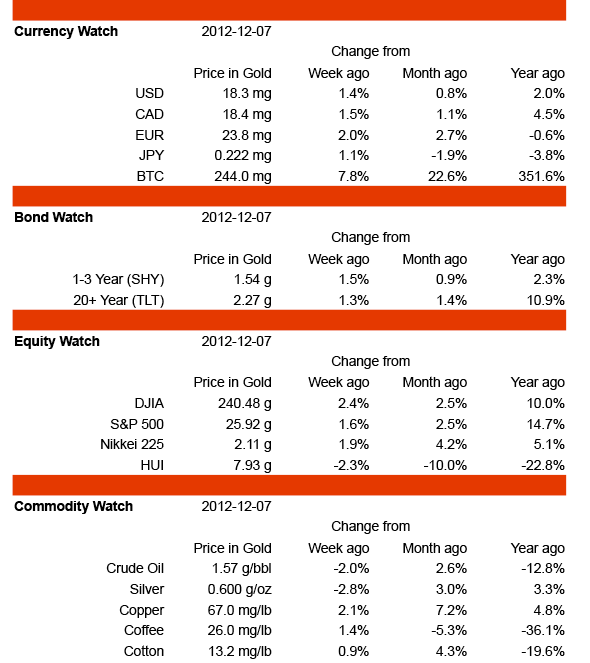
Table of prices in gold for week ending 11/2/2012

Filed under monetary universe by  #

0

Since 2001, the US Dollar has lost half of its value every 4 years.  Of course, its actual value dithers about, sometimes more than this theoretical value and sometimes less, but as you can see from the chart below, it tracks very close to this decay line.  The chart below also projects this line into the future, giving a reasonable guess at what the continuation of the last decade's policies will do to the USD's value in gold terms.

Will these policies continue? There is no way to be certain; if debasement is pushed too hard, people may lose confidence, leading to a dollar collapse. But to reverse the trend would push interest rates sky high, and result in budgetary and monetary chaos as well. Thus a continued steady devaluation of the dollar is likely the "best case" central bankers can achieve.

I have added this page to the Charts section of the site under the heading Half-Life of the US Dollar so you can follow along and see how this prediction unfolds.

USD Forecast:


click on the chart to download a pdf

Filed under US Dollar by  #

0

Government issued currencies were little changed this week, with the USD strongest, up 1.2%. The USD continues to trade very close to its Half-Life curve, now 2.0% above the projected value.  Bitcoin (BTC) however, got slammed, plummeting 11.3% for the week to finish at 186.9 mg. In trading over the weekend the BTC recovered slightly, to 193.7 mg.

While Bitcoin was the weakest asset, long term US treasury bonds were the strongest..  TLT rose 2.0% to 2.22 g, while SHY moved up 1.2% in line with the USD. 

Conventional equities were all down, but only slightly; the Nikkei was weakest, off 0.7%.  Gold stocks were the only equities in the plus column, with the HUI rising 0.3%..

Commodities were all lower this week, led by cotton, which gave up about half of last week's gains (down 4.6%) and crude oil, which lost 3.0% to close at 1.56 g/bbl.

Bitcoin priced in gold

TLT priced in gold

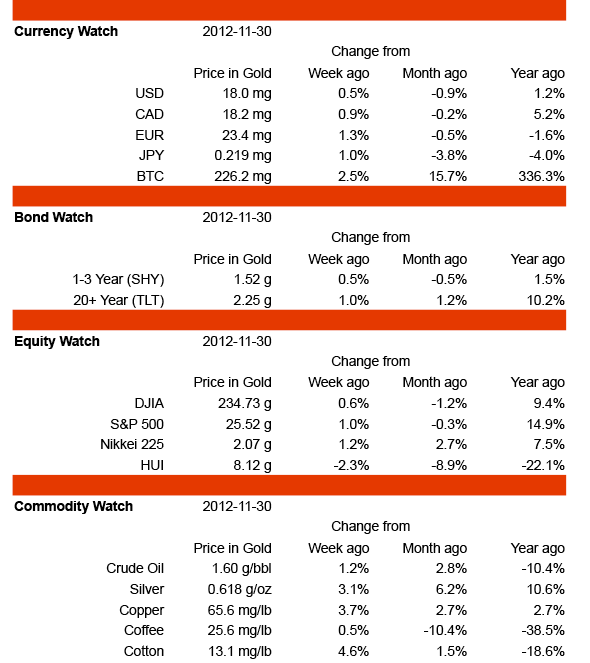
Table of prices in gold for week ending 10/26/2012

Filed under Bitcoin, Bonds, Cotton, Stocks, US Dollar by  #

0

All of the government currencies were strong again this week, led by the EUR, which rose 3.4%. Bitcoin (BTC) declined slightly, giving up 0.7% for the week to finish at 210.6 mg.

Bonds were mixed.  SHY moved up 1.6% (in line with the USD, as usual) but TLT was off 0.1% to 2.18 g. 

Equities were all on the plus side of the ledger, led by the Nikkei 225, which rose a whopping 6.0% to close at 2.04 g. This more than made up for last week's drop, but still leaves the Nikkei index about 15% below its 2009 lows.  The S&P 500, by contrast, rose 2% to close about 14% above its 2009 lows.

Commodities showed the largest gains and losses this week, with cotton rising 9.6% and silver falling 2.7%.  In cotton's case, this is coming off a recent all-time low, but is enough to turn the commodity's price action positive for the last month.  Silver closed at 0.579 g/oz, close to the 0.6 level that has been its home for the last year.  Copper was unchanged, crude oil was off 0.3%, while coffee rose 1.7% leaving it 2.4% above its recent all-time low.

Cotton priced in gold

Silver priced in gold

Table of prices in gold for week ending 10/19/2012

Filed under monetary universe by  #

1

Another great email this week:

I often hear that Warren Buffet thinks gold is a lousy "investment" when compared to stocks.  What I've never seen is a long-term comparison of gold versus BRK-A or other well-known "successful" funds.
Any chance of seeing a chart of BRK-A in gold? 

I've been keeping that chart for years, but haven't updated it lately.  You can check it anytime at stockcharts.com with the symbol "BRK/A:$GOLD".  Basically, Berkshire did great until 1999, and has been lousy from then until about a year ago, falling 85% and giving up all of it's gains back to 1995.  The last 12 months have been pretty good, but if you bought BRK-A anytime between 1996 and 2011, you are still underwater.
 
Here is a chart of BRK-A in ounces of gold:
 
BRKA 1995
 
Cheers,
 
 
Sir Charles

Filed under monetary universe by  #

5

I recently received the following email:

I have the option of taking a lump sum payment of approx. $90,000 now or waiting until I retire and receive a monthly payment of $500.  I can expect to live at least 20 to 25 years from the time I can start receiving the monthly payment.
 
If I take the money now, I will be taxed 20% and also get hit with another 10% penalty if I take it now.
 
On paper it would seem that I would get more money by taking the monthly payments but since I won’t start those payments for another 10 to 15 years, I'm really worried about what my money will be worth 15 to 35 years from now.
 
I’m thinking about taking the payment and investing in gold and silver but the investment would have to go up 50% just to make up the 30% I’d lose to taxes and penalty.
 
I could roll it over to an IRA but I’m too close to retirement to take much risk.
 
Any suggestions? 
 
What a great question!  Here is my answer:
 
I think you are on the right track… I'm not trained, registered, licensed or otherwise "qualified" to give this kind of advice, so all I can say is that if it were MY money, I would definitely take the cash now, while it's still worth something, and hold it in gold, or better yet, in investments that have a good chance of increasing their gold value, until I needed it for retirement.
 
A quick look at the Half Life of the Dollar curve will tell you why this is the way to go.  Every 4 years, the USD loses half of it's purchasing power.  So if you wait 8 years to get your money, you will be getting paid in dollars that have about 25% of the purchasing power of today's dollars.  In 12 years, the dollars you're getting will be worth about half of that – they will only buy 1/8th of what dollars can buy today, and so on.
 
And this assumes that there is no catastrophic "fall off the monetary cliff" where the USD suddenly goes into a confidence nose-dive in which it either self-destructs, like the Zimbabwe dollar, or manages to avoid complete annihilation but becomes a secondary currency like the pound sterling, or a marginal currency like the Argentine Peso. Under these scenarios, things could be much worse than the curve suggests!
 
With the incredible levels of public and private debt that exist today, I don't think that significantly increasing the purchasing power of the USD is politically possible.  To do so would require sending interest rates to the stratosphere – a policy that would bankrupt the US government and destroy the world's financial system.  As Doug Casey says, the chances of that are between slim and none, and slim just left town.
 
Let's run some numbers to see how this plays out.  If I take the cash now, pay the taxes and penalties, I get $63,000 of today's dollars, which will buy about 1,100 grams of gold:
 
Lump Sum Now: $90,000
Less Taxes: ($18,000)
Less Penalty: ($9,000)
Net USD: $63,000
Net Gold gr: 1,126
 
If I wait ten years, and then receive $500 a month for 25 years, I get a total of $156,000 dollars, which will only buy about 130 grams of gold.  In other words, a total of about $7,250 in today's purchasing power spread over 25 years.  This is the "I'm lucky if I'm eating dog food" retirement plan:
 
Year Nominal USD Gold gr Today's USD
2022 $6,000 20.526 $1,149
2023 $6,000 17.316 $969
2024 $6,000 14.601 $817
2025 $6,000 12.318 $689
2026 $6,000 10.392 $582
2027 $6,000 8.766 $491
2028 $6,000 7.392 $414
2029 $6,000 6.236 $349
2030 $6,000 5.261 $294
2031 $6,000 4.438 $248
2032 $6,000 3.742 $209
2033 $6,000 3.157 $177
2034 $6,000 2.663 $149
2035 $6,000 2.247 $126
2036 $6,000 1.895 $106
2037 $6,000 1.598 $89
2038 $6,000 1.348 $75
2039 $6,000 1.137 $64
2040 $6,000 0.959 $54
2041 $6,000 0.809 $45
2042 $6,000 0.683 $38
2043 $6,000 0.576 $32
2044 $6,000 0.486 $27
2045 $6,000 0.410 $23
2046 $6,000 0.346 $19
2047 $6,000 0.292 $16
Total Benefit: $156,000 129.594 $7,253
Now 1,126 grams divided evenly over 25 years isn't a lot to retire on… about $2500 per year in today's buying power. But compare that to what I would get if I leave the money in the system!  The first year, about half that much… and every year after that, less and less.
 
Of course this is all projections, and the real numbers will sometimes be higher and sometimes lower, but I suspect this paints a fairly realistic picture.  The true surprises will be wars, natural disasters, flash market crashes, etc.  How will the USD and Gold react to these?  No one knows for sure, but I would sleep better with a bag of gold coins than I would with a bag full of paper money… or worse: a bag full of promises to pay me paper money!
 
And if things go really well for the US economy and the USD starts to rise in purchasing power, I could speculate by selling some of my gold and buying some treasury bills or stock index ETFs. I just need to remember that I am playing a bear market rally, and keep a close eye on my trailing stops.  When the rally ends, I can sell the treasuries and use the funds to buy gold, ending up with more gold than I started with.
 
So my suggestion is to take the money now, pay the taxes and penalties, and rather than turning it all into gold and salting it away, invest part of it in something that will grow – in gold value – over the next 10 years, and if possible, generate income for you during the 25 years that follow.  Possibilities include starting your own small business, carefully selected real estate deals, and others that I will be writing about in the future.
 
I hope you find this useful.
 
Cheers,
 
Sir Charles
 

Filed under monetary universe by  #

0

All of the government currencies were strong this week, with the CAD up 1.5%, JPY up 1.4%, and even the battered EUR showing a 0.5% gain. Bitcoin (BTC) however, took a beating, dropping 11% early in the week, but recovering some ground to finish the week down 4.6%. Remember my comments from last week: the BTC is a highly volatile young currency. Expect to see it mentioned often as one of the biggest winners or losers!

Bonds were also big winners this week.  SHY moved up 1% (in line with the USD, as usual) but TLT was the biggest gainer for the week, rising 3.3% to close at 2.18 grams, more than making up last week's loss. 

Equities didn't fare so well: they were all down, led by the HUI gold stocks, down 2.6% and the Nikkei index, off 2.4%. US stocks were also lower, with the S&P 500 closing down 1.3%.

Commodities were a mixed bag, with coffee setting another all-time low of 28.3 mg on Thursday, before recovering 0.7% to close the week down 2.9% at 28.5 mg/lb.  Silver declined 2.1%, but remained near the 0.6 gram level that has been it's home for the last year.  Cotton and crude oil each gained 3.2% for the week. In spite of this week's gain, Cotton remains very close to it's all time low of 12.1 mg/lb, set at the end of September.

TLT in Gold

Coffee in Gold

Table of prices in gold for week ending 10/12/2012

Filed under monetary universe by  #

2

Currencies were weak this week, with the EUR treading water up 0.1%, while the USD and CAD fell 0.4% and 0.6% respectively.  The weakest of the bunch was the JPY, down 1.5%.  This week I am starting to include coverage of Bitcoin (BTC). As you can see from the chart below, bitcoin has had a meteoric rise over during the last two years since its introduction, though this has been punctuated by sharp declines. This volatility is caused by the currency's youth: it is being adopted by thousands of new users each week, and this rising demand is pushing its value up. But any time there is a rumor of a theft or concern about a government crackdown, the value can tumble sharply.  This week, BTC is the only currency to show much strength, and over the last month, and the last year, it outshines all other investment categories.  Worth keeping an eye on!  Learn more at bitcoin.org.

The biggest losers this week were commodities, coffee and crude oil.  Coffee fell 3.5% to 29.3 mg/lb, while crude dropped 2.9% to 1.57 g/bbl. Cotton took a breather this week after big drops in prior weeks, closing up 0.5% at 12.2 mg/lb.  Silver also gained slightly for the week, rising 0.1%.

TLT (the long term US Treasury Bond ETF) was the other big loser, off 2.7% to close the week at 2.11 g.  The shorter term SHY traded lower in line with the USD, dropping 0.5%.

Stocks were mixed, with US equities up (the S&P 500 rose 1%), while the Japanese Nikkei and the Gold stock index (HUI) were down 1.6% and 0.4% respectively.

Bitcoin in Gold

Table of prices in gold for week ending 10/05/2012

Filed under monetary universe by  #

0

The Euro fell again this week to another record low of 22.56 mg, before recovering slightly to close down 0.3% at 22.60 mg. For the YTD, the EUR is down 11.6%.  The USD and JPY rose slightly (0.5% and 1.2% respectively), while the CAD was little changed, down 0.1%.  The USD remains very close to its Half Life curve, ending the week 2.7% below the predicted value.

Cotton, the biggest loser for the week, continued its slide, setting a new record low of 12.1 mg/lb, down 3.5%. Other weak asset classes include the HUI gold stocks, down 1.8% and the Nikkei index, down 1.4%.

Once again, TLT, representing the long term US treasuries, was the strongest performer for the week, rising 2.7% to 2.18 g. Although TLT has been recovering, it is still far from resuming it's uptrend of the last year, sitting below its 200 day moving average, which suggests resistance at about 2.27 g. If that resistance is tested and holds, it could provide a good opportunity to short the long bonds.

TLT - Long US Treasury Bond ETF

Table of prices in gold for week ending 9/28/2012

Filed under Bonds, Cotton, EUR, Stocks, US Dollar by  #