0

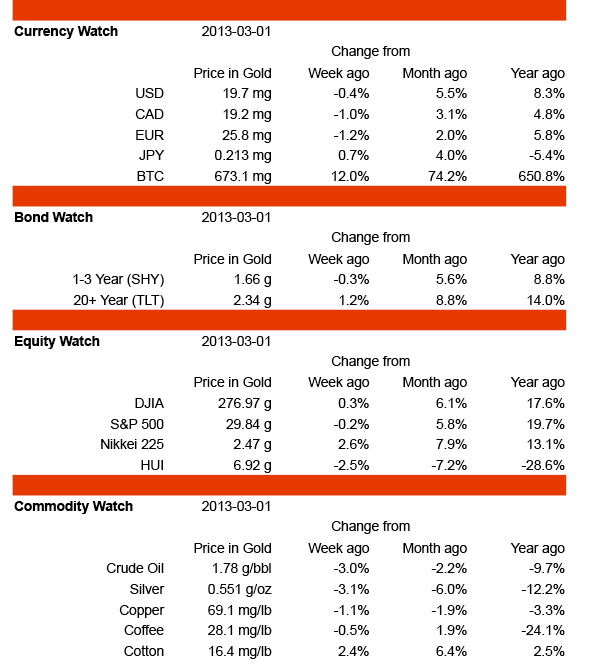
Stocks, bonds, and currencies (other than Bitcoin) were weaker this week, while commodities, with the exception of copper, were higher. 

Among the government issued currencies, the Japanese Yen was weakest, falling 2.8%, while the Euro was the "least weak", declining only 0.3%. The US Dollar ended 2012 right at its 200 day moving-average, pushed above it in early January – reaching 18.9 mg on Jan 7th, 10.1% above the half-life predicted value – and has since retreated, ending this week at 18.4 mg, down 1.2%, and sitting 7.8% above the half-life curve forecast.

Bitcoin, the free-market internet currency, was the strongest asset on the list this week, rising 9.1% to close at 288.8 mg. This is the highest level seen since July 2011, and is higher than any trading period except the 5 weeks in June and July of 2011 when the BTC spiked to 598 mg on June 9th. In the next few months, look for significant resistance between 320 and 350 mg. Once that is overcome, there there is little in the way of a retest of the old high.

Bonds were lower, with the long term TLT (down 1.7%) falling a bit less than the short term SHY (down 1.8%). TLT flirted with its 200 day moving-average at the end of 2012, reaching a peak 1.4% above the average on December 28th, then closing decisively below on January 2nd.  TLT now sits 3.6% below the average at 2.21 g.

Among the equities, gold stocks were the weakest, with the HUI off 2.6% (the largest drop for any asset class this week), followed by the Nikkei Index, which was down 1.8%.  The S&P 500 fell 0.9% this week, but is up 2.7% for the year so far.

Among the commodities, cotton was the biggest gainer, rising 2%, followed closely by silver, up 1.8%. Crude oil and coffee rose slightly, while copper declined 1.4%.  Platinum (not on the list below) finally traded above gold parity this week, 0.5% above gold on Jan 17th, but dropped back to finish the week up 1.2% at 30.89 g/oz, 0.7% below parity.

US retail gasoline continues to hover near its all-time low at 61.7 mg/gal, and the UN's international Food Index for December is also near its lows at 43.4. The sugar and oils components of the index are at new all-time lows.

Table of prices in gold for week ending 18-Jan-2013

1

I have received several questions lately along the lines of, "What do these charts mean?", and "How do I interpret this chart?". This post is an attempt to answer these questions.

Price charts are simply a series of marks showing how the price of a thing has changed over time.

So what is a price, and what does it mean? The dictionary says a price is "the amount of money expected, required, or given in payment for something". But price often refers to something other than money; for instance the price you pay for eating too many deserts might be that you no longer fit well into your old clothes.  

Prices are really about tradeoffs. "Would I rather have this, or that?":  ten gallons of gasoline, or $35? an ounce of gold, or $1650? a kilo of gold, or a year's tuition at Yale?

Each time a trade happens, both sides come out better off than they were before they traded – both make a profit.  If I am hungry, I might value an apple more highly that the dollar in my pocket. And the merchant who sells me the apple would rather have the cash. He has more apples than he can eat, but his pen just ran out of ink and he can use the cash to buy a new one.

The prices of things reported every day are determined by millions of sellers and buyers making  these trades. Sellers who offer goods too cheaply can't stay in business for long, and sellers who offer goods too expensively will be undercut by others and likewise go out of business. This process is called "Price Discovery".

Factors like supply and demand, fashion preferences, technology, and demographics cause some items to command higher prices than others. And over time, these factors change, causing some things to become more expensive while others become cheaper.

Prices are usually quoted in the local currency, or in US Dollars (currently the world's primary reserve currency).  But when these currency units are gaining or losing purchasing power over time, it becomes hard to compare prices from two different dates. It is hard to see the real changes in prices because they are obscured by changes in the value of the currency itself.  And the biggest driver of these changes in currency values come from central banks changing reserve requirements and issuing new money through a vast array of schemes.

As prices are published and quoted, they influence buying decisions in many areas of the economy. For instance, gas prices may change the number of type of cars being purchased. House prices affect decisions to rent or buy a home. Food prices affect what we eat, where we choose to live, even how many children we have. When these prices are misquoted or misunderstood, people can be lead to make poor decisions.

This is where gold comes into the picture: it is a form of money that has been in use for thousands of years, is recognized and valued world-wide, but is NOT issued by any central bank, and therefore is perfectly suited to tracking prices of things through time. To find the price in gold for a thing on a certain date, simply take the thing's price in dollars on that date, and divide by the price of gold in dollars on the same date.

What does this number mean?  Well, if you sold the thing, this is the amount of gold you could buy with the proceeds – the thing's price in gold.  Or to turn it around the other way, if you wanted to buy the thing, this is the amount of gold you would have to sell to get the cash to buy it – again, its price in gold.

As we learned earlier, price charts are simply a series of marks showing how the price of a thing has changed over time.

Let's take a look at a sample chart, in this case, Berkshire Hathaway B Shares, priced in gold:

See the horizontal blue line just below 2.0? That marks the price of BRK-B on Jan 10th, the last point on this chart.  At the close on Jan 10, you could have sold one share of BRK-B, and received enough cash to buy 1.76 grams of gold.  On that day, the two things, one BRK-B share and 1.76 grams of gold, were being given the same value by the buyers and sellers in the market.

If you had bought that share any time after Q1-2011, you would have paid less than 1.76 grams for it, so you could have sold it on Jan 10th for a profit, receiving more gold than you paid to get it.  If you bought it at any time between 1997 and Q1-2011 (except for a few weeks in early 2009), you would have paid more than 1.76 grams of gold to buy it, and selling it on Jan 10th would have returned only part of your initial investment (ie., you would be taking a loss).

One way to read this chart is to think of it as comapring two investment strategies: holding physical gold, or holding a share of BRK-B. During 1997, you were far better off holding the B share. In fact, every gram of gold invested in BRK-B would have doubled or tripled! In 1998, BRK was extremely volatile, and holding gold would have given about the same return with less risk. 1999 was a disaster for BRK; you would have been much better off holding gold. In 2000 and 2001, BRK recovered strongly, but failed to break out above its 1999 high. From 2002 to 2011, you would have been far better off to own gold than BRK-B; for every 100 grams of gold invested in BRK-B shares in 2002, only 20 grams remained at the bottom in 2011.  But since then, the shares have outperformed gold.

Clearly, if you could "buy low and sell high", trading your gold for stock when the stock was cheap (1996) and selling and putting the proceeds into gold when the stock was expensive (1998 or 2001), and selling the gold and buying the stock again in late 2011, you would now be sitting on almost 5 times the amount of gold you started with in 1996, after just 3 trades.  And since the US Dollar is worth about 1/4 as much today as it was in 1996 (when gold was under $400/oz), your investment today would be worth about  20 times as many dollars as it was in 1996!

Having good price information is key to making good economic and investment decisions. When governments and central banks are debasing their currencies, it becomes difficult to read what is really happening to the prices of the underlying commodities or investments. It is easy to think your investment is going up, even though it is falling, because the weakening currency makes all prices look higher than they really are.

That's why it is so important to always price in gold.

Filed under monetary universe by  #

0

This was a volatile week, but most of the volatility was to the upside.

Among the currencies, the EUR was strongest, rising 4% to close at 24.9 mg.  The USD was second, up 2.7%, closely followed by BTC, which gained 2.4%.  The laggard was the JPY, which still managed a respectable 1.8% gain. More comments on the USD later in this post.

Bonds rose this week, but both long and short term treasuries rose less than the underlying USD, with the short term SHY gaining 2.6%, and long term TLT rising only 1.6%.  Even so, TLT managed to get back above its 200 day moving average on Friday, so the jury is still out on whether this retest of resistance will be the start of a new leg down, or a breakout to the upside.  Stay tuned!

Stocks were all higher, lead by the Nikkei and the S&P 500, which each rose 3.9%. The HUI gold stocks were the weakest, rising only 0.3%. At 2.22g, the Nikkei bears close watching, as it is getting near the resistance area around 2.3 g.  This area was support in early 2009 and early 2011, but after the breakdown in August of 2011, it has been retested several times as resistance. As with TLT, we will have to wait and see if the rally runs out of steam around 2.3 g, or breaks through to start a new uptrend. 

Commodities were mixed, with coffee, crude oil and cotton higher, while silver and copper fell.  Coffee showed a huge 9.6% gain, but this was mostly due to the expiration of the December futures causing the price to shift to the March contract. Just as it was going off the boards on the 18th, the Dec contract made a new all-time low at 133.5 mg/lb. Crude oil continued last week's rally, rising a further 5% to close at 1.67 g/bbl. Silver was the week's biggest loser, falling 5.6% to close at 0.563 g/oz.

To my mind, the big news of the week was that the USD is finally approaching overbought  territory. I follow the half-life of the USD closely, and try to buy USD (and USD denominated assets) when they are undervalued, i.e. when the actual price of the USD is below the predicted curve, and sell USD related assets when the USD is strongly above the predicted value. Here is a new chart showing how far above or below predicted value the USD has been over the last decade.

As you can see, whenever the USD gets more than 10% above the curve, it represents a pretty good time to sell.  At 20% above the curve, it is a screaming sell!  The reverse is true when the USD is undervalued by 10% or more – that's the time to sell some gold and acquire USD assets.

The last time the dollar was this far overvalued was back in August of 2009, when gold was about $935 per ounce. To get back to the 25% overbought level (last seen in late 2008, when gold was $713/oz) gold would have to fall to about $1,450 in the next few weeks.

I do think it is much riskier to play the long side of the USD than the short side. The long term trend is down, not up. And the recovery from oversold conditions assumes that the central banks will be able to do something to inspire confidence in the currency, or at least instill a sense of fear about holding other assets. If they are unable to to this, the dollar could enter free fall rather than reverting to the mean.

In any case, we are now about 8.8% above the curve, approaching the magic 10% level where we will want to be selling USD and USD related assets, and either going to cash (gold) or buying assets like high quality gold stocks, productive farmland, or strategic metals that have a good record of appreciating when the USD falls.

Table of prices in gold for week ending 12/21/2012

0

This week's largest price swings were in the commodities, with coffee the biggest loser, falling 3% and setting another new all-time low, and cotton the biggest winner, up 4.3% to close at 13.8 mg/lb.  Crude oil continued to rise this week, up 1.2% to 1.59 g/bbl, while silver continued its decline, dropping 0.7% to close at 0.596 g/oz.

Platinum also continues to work its way higher, rising 0.7% to close at 29.58 g/oz. This is still a 4.9% discount to gold.  Over the last 12 years, platinum's premium to gold has averaged 67%, so there is still plenty of profit potential at these levels.

Currencies all extended last week's rally, except for the Yen, which gave up most of last week's gains to close at 0.220 mg. Bitcoin once again was the strongest currency, rising 1.9% to close at 248.6 mg, approaching its 2012 high of 256.5 mg.

Short term bonds rose 0.3% in line with the USD, but the long term treasuries, represented by TLT, fell 0.4%. Last week, TLT's rally closed right at the 200 day moving average resistance level; rather than breaking out, prices fell early this week, and closed well below the 200 day average. This may signal the start of a new move down for TLT.

Equities were all higher this week, led by the gold stocks (HUI up 1.2%) and by the Nikkei (also up 1.2%). Japanese stocks continue to outperform the Yen.

Table of prices in gold for week ending 12/14/2012

0

Most assets were higher again this week, with bitcoin leading the way.  Silver, gold stocks and crude oil were the only exceptions.

Currencies were all higher, but bitcoin was in a league of its own, rising 7.8% to 244 mg. The  Euro was in second place, gaining 2% to close at 23.8 mg. The weakest of the bunch was the Japanese Yen, which still rose a respectable 1.1%.

Bonds were higher, with longer maturities lagging behind. SHY rose 1.5% (a bit more than the USD's 1.4% gain) while TLT was up 1.3% to 2.27 g. TLT finished the week right at its 200 day moving average; it will be interesting to see if that proves to be a support level in the week ahead.

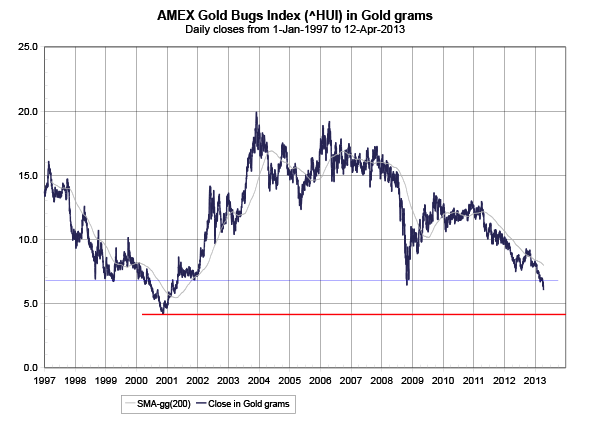
Equities (other than the Gold Bugs Index) were higher, led by the Dow Jones Industrials, which added 2.4% to close at 240.48 g. The Nikkei Index rose 1.9% and the S&P 500 gained 1.6%. The HUI gold mining stocks fell 2.3% to close at 7.93 g. About one month ago the HUI dropped below it's 200 day moving average, and since then it has fallen 7.9%. Look for support around 7.5 to 7.6 g.

Commodities were mixed.  On the downside, silver fell 2.8% to 0.6 g/oz, and crude oil lost 2% to finish the week at 1.57 g/bbl. Among the metals, silver was the exception: copper rose 2.1%, while platinum was up 0.3% and palladium gained 3.4%.

Table of prices in gold for week ending 12/7/2012

0

Every asset class except gold stocks was higher this week.  The HUI 'Gold Bugs' index fell 2.3% to close at 8.12 grams, about 8% above its low for the year.

The strongest assets were commodities. In the lead was cotton, which rose 4.6% this week to close at 13.1 mg/lb – recovering most of last week's losses, but still trading only 8% above its all-time low of 12.1 mg/lb set two months ago on Sep-30.  Copper and silver were also strong, rising 3.7% and 3.1% respectively. Even coffee, which continues to trade just above its all-time low, caught a break this week, rising 0.5% to close at 25.6 mg/lb.

Bitcoin again outperformed all of the government issued currencies, gaining 2.5% for the week to close at 226.2 mg. The Euro rose 1.3% and the Yen gained 1%, while the USD lagged behind, up only 0.5%.

Long term bonds outperformed short term bonds this week, but neither was able to make up for their heavy losses last week. SHY gained 0.5% (in line with the USD) while TLT rose by 1% to close at 2.25 g.  TLT is getting close to its 200 day moving average, and next week may bring a test of that key resistance level.

Putting gold stocks aside, the major equity indicies were all up this week.  The Nikkei, helped by the strengthening Yen, rose 1.2% while the S&P 500 rose 1%.

Table of prices in gold for week ending 11/30/2012

0

S&P just released the latest numbers for the Case-Shiller home price database, bringing the series up to September, 2012. Priced in US Dollars, the ten city composite known as CSXR has been rising steadily for all of 2012, and rose again in September from August's 155.18 to 155.63.  This means that in those ten cities, used house prices in USD, as tracked by index, were about 56% higher in Sep-2012 than they were in Jan-2000.

When priced in gold, the index fell from 28.17 in August to 26.71 in September, a 5.2% drop. This leaves the index about 10% above its recent low of 24.30, set one year before in Sep-2011. Compared to the benchmark 100 index of Jan-2000, home prices in gold are down 73%.

CSXR in USD and Gold

The big question is, does this represent a bottom for the housing market?  These recent values are lower than any historical values going back to 1987, when the index was first constructed. But we have longer data series as well.  Let's see what they show us.

First, there is the median sales price of new homes sold in the US, published by the US Census Bureau, which goes back to 1963, and gives us prices up to Oct-2012. The median new home price is currently about 4.1 kg. Its all time low, set back in 1980, is just under 3 kg. This suggests that new home prices may have about 25% further to fall.

Going even deeper in the past,  Shiller has also attempted to construct a National Home Price Index that extends the S&P's Case-Shiller series back to 1890. This quarterly index sits at 23.49 for Q3-2012.  Its all time low was 20.06 in Q1-1980, putting the current level about 17.5% higher.

Of course, there is no reason prices have to retest their old lows… but it happens more often than not.  If it does occur, it could happen in several ways: through a drop in nominal USD prices, or through a reduction in USD value – also known as a rise in the gold price.  Most likely, it will be a combination of these.

The old lows may offer support, but that support may fail, as it did in the last half of the 1970s – leaving prices to find a new bottom deep in uncharted territory.  And even if support does hold, prices may pop quickly, as they did in 1981, or it may take years of "base building" at the support level before a new bull market emerges, as it did in the 1930s and early 1940s. 

Real estate values also vary dramatically from place to place, so some may have already bottomed when others are still falling. Internationally, there are markets that are currently much closer to their highs than to their old lows.

If you are a very long term investor, with a time horizon measured in decades, it might be time to start looking for select situations and building a portfolio of choice properties.  But be patient, and expect that there could be further declines in home prices as measured in gold.  Use these declines to add to your collection. I think that over the long term, you will be well rewarded.

Also take a look the charts of farm, timber and commercial property prices. Of these, farmland seems the most robust, and I would certainly consider adding it to your shopping list.

Filed under Real Estate by  #

0

Currencies and bonds reversed course this week, with all but Bitcoin moving lower. Stocks rose across the board, with the HUI gold stocks leading the way, and the Nikkei, hindered by the weak yen, rising the least. Commodities were mixed, with metals and energy higher, while cotton and coffee moved lower.

Bitcoin, the strongest asset of the week, rose 5.8%, to close at 220.5 mg. JPY, the weakest of the currencies, fell 3.3% to close at 0.217 mg.  The USD was down 1.2%.

Short term bonds, as measured by SHY, fell in line with the USD, but TLT, our proxy for long term bonds, fell 2.9% to close at 2.23 g.  TLT continues to hold above its 200 day moving average, but hasn't yet made a bullish breakout.

Among the commodities, Silver was the leader, rising 2.3% to close at 0.599 g/oz, while cotton, down 5.1%, was the weakest.  Coffee was also very weak, making new all-time lows again this week, and closing down 4.7% at 25.5 mg/lb.

Table of prices in gold for week ending 11/23/2012

0

This was a good week for most asset classes, with currencies and bonds all higher, stocks mixed, and commodities all higher except for coffee, which made a new all-time low of 26.3 mg/lb on Tuesday, but rallied to finish the week down 0.3% at 26.7 mg/lb.

Bitcoin was in a league of its own this week, rising 7% to close at 208mg. The EUR was the strongest conventional currency, up 1.5%, followed by the USD which rose 1.4%.  The JPY was the weakest, gaining only 0.2% for the week.

Treasury Bonds were strong, with the SHY gaining 1.5%, a bit more than the underlying USD, and the longer term TLT advancing 1.8% to close at 2.29 g.  TLT is holding well above its 200 day moving average, and continuing to rise back into its old trading channel.  A bounce off the 200 day average, testing it as support, might make a good entry point on the long side.

Stocks were mixed, with the Dow Jones Industrials down 0.4%, the S&P 500 unchanged, and the Nikkei Index up 3.3%.  The big loser this week was the HUI Gold Bugs Index, which fell 7.1% to close at 8.00 g, punching decisively through its 200 day moving average, and approaching its 7.5 g low for the year.

Coffee was the only falling commodity. Cotton was the leader, rising 6% to close at 13.2 mg/lb, followed by crude oil, which was up 2.4%.  Silver and copper rose 1.8% and 1.7% respectively. 

HUI priced in gold

Table of prices in gold for week ending 11/16/2012

1

For the first time in quite a while, every asset class was lower this week.

The least weak asset was the long term treasury bond fund (TLT) which declined only 0.1%. The US election result, the impending "fiscal cliff", and massive tax hikes coming in only a few weeks, combined to drive the animal spirits into a frenzied flight to safety, with gold just barely edging out T-Bonds as the market's choicest safe haven. From a technical perspective, TLT is worth watching in the near future. This week it broke above its 200 day moving average on massive volume, and has stayed above for several days. If this support level holds, it could signal a return to its previous trading channel, with significant upside potential.

All the currencies were lower, but the EUR was the weakest, down 4.6% to close at 22.8mg. The USD, CAD, and JPY were in the middle of the pack, down about 3% each, while Bitcoin showed relative strength by dropping only 0.5% in value.

While long term treasuries were treading water, the short term instruments represented by SHY fell 3%, in line with the USD.

Equities were all down for the week, with Japan's Nikkei Index falling the furthest, taking a 6% loss. The S&P 500 fell 5.4%, while the Gold Bugs Index (HUI) fell "only" 1.7%, a strong showing in this weak crowd.

Commodities were also lower across the board, led by coffee, which dropped 6.1% as it made a series of new all-time lows. Coffee isn't the only foodstuff making new lows, however.  The UN Food and Agriculture Organization's Food Price Index (chart below) also made a new low, with every category (cereals, meats, oils, dairy and sugar) also making record lows. Overall, food prices are about half what they were 5 years ago, and about a third of what they were ten years ago. Good news for gold-based shoppers!

TLT priced in goldFood priced in gold


Table of prices in gold for week ending 11/9/2012

Filed under monetary universe by  #