
Reader Tony Lewis recently wrote to me with some excellent questions:
So when looking at your charts, in your opinion, would it be sound to buy when something is historically low in terms of gold grams? And what about gold itself? Is there a chart that determines when to buy gold?
Let’s start with the last question first: When should you buy gold?
To me, this is the same as asking, “When should I hold cash?” Owning physical gold insulates you from many forms of loss, especially the subtle forms, like loss of purchasing power through currency depreciation. It avoids counter-party risk. Really your only risk is physical theft. However, like cash, you have no upside. If you put 1 kg of gold in a safe, it will always be just 1kg of gold. It won’t ever grow, or pay dividends, or add further to your wealth. In 50 years you can come back, open the safe and still find 1 kg of gold sitting there waiting for you. So you have downside protection, but no upside.
I think everyone should have a “cash cushion”. Part of this would be in local currency, to help cover bills and expenses in an emergency. And part of it should be in gold, to cover the possibility that the currency could become worthless, either suddenly, or gradually over time. If you are saving up for a big purchase or expense in the future, like a child’s college tuition, your retirement, or a new house, it could make sense to do that saving in gold. The further in the future, the more sense gold makes.
The current price of the dollar in gold really isn’t relevant. The dollar goes up and down all the time, depending on many factors: monetary policy, the state of the economy, fears of terrorist strikes, military actions, etc. Sometimes people are in desperate need of dollars to pay down debt, other times they don’t want to hold dollars because they are depreciating so rapidly. Gold doesn’t suffer from these factors. It just sits there. So as an anchor to a portfolio, to reduce volatility, and to provide stability in uncertain times, gold is the perfect asset. If you don’t feel you have enough, buy more now! The price of the dollar (or conversely, the dollar price of gold) just doesn’t matter.
If you are trying to make a profit by trading in dollars, the situation is more complex. Assuming that you are starting with some dollars, you want to find a point when the dollar is overpriced, and use that strength to buy a lot of gold for a small number of dollars. Then when the dollar falls, and becomes fairly priced or even under valued, you want to use that gold to buy a lot of dollars. Lather, rinse, repeat. At each iteration, you should have more gold than you had before – you are making a profit by trading in dollars. This sounds simple, but is difficult in practice.
As the long term trend of the dollar is down, you are really playing bear market rallies to make your profits. Trading against the trend like this can work, but it is quite risky, and requires care and attention. And there is always the risk is that while you are holding dollars and waiting for them to appreciate, they will instead become worth much less, or even become worthless.
My assessment is that the dollar is currently vastly over-valued, with much more downside than upside. This doesn’t mean that it cannot become even more over priced. Still, I have been selling my dollars and buying other things with them, including gold, silver, platinum, real estate, crypto-currencies like Bitcoin, and value stocks. Gold for portfolio stability, and other assets that I think will grow in gold value over time. I don’t care whether they become worth more dollars or not. I want them to be growing in gold value.
This leads naturally back to the first question.
Is it a good idea to buy things that are at historically low prices? Of course, the old adage is to “buy low and sell high”, and this suggests that when things are historically cheap you should buy them… but the fact that something is cheap doesn’t mean that it can’t get even cheaper!
The real key is find things that are good values, assets whose value is under-appreciated by the market. This requires research into the fundamental value of the asset (supply and demand for commodities, management, cash flow and balance sheet for businesses). Over the years, stocks have grown in gold value, but they have long periods of falling value followed by long periods of growth in value. Here is a long term chart of the S&P Index, for example:

If you have a really long view of your investments, it is probably fine to buy most things when they are at or near historic lows. Assuming that the asset will still have value in the future (like durable commodities, solid companies producing perennial products, etc.) you may have to wait a few years, or even a decade, before they once again start to shine, but eventually you will see profits. Buying at the top of the trading range, you might have to wait much longer… and in some cases, you might never see profits. Examples are Coffee in 1997, Palladium in 2001, and Uranium in 2007. Or US stocks in 2000.
But note the caveat in the previous paragraph, “assuming that the asset will still have value in the future”. I would not include most government issued currencies (especially the USD, JPY and EUR), government bonds, and even many stocks (especially small caps) in that category. These are things that can certainly be traded to grow the gold value of your portfolio, but they are traded on a short term basis, and have to be watched carefully. If you aren’t a full time trader, they should be traded with small position sizes, so that a complete loss will not hurt your portfolio too much. They can be speculative opportunities, but are not long term investments.
Turning back to US stocks, the S&P 500 is far cheaper now than it was in 2000 (about one-third the price) and considerably less than it was in the late 1960s. However, it is a bit higher than it was in 1929, and in fact, is higher than it has been for all but 20 or so years out of the last 135. So I would not rate it as “dirt cheap”.
Although stock prices have been rising for the last several years, I am concerned that the current US stock market looks more like 1978 than like 1985. If so, buying today might mean suffering through an 85% loss and waiting 15 years just to break even – but bought without debt, and held for the long term (maybe 30 years) you could still make 4 or 5 times your initial investment at the top of the next wave.
For those of us with a shorter time horizon, the best plan may be to treat stocks as short term speculations, going long while they are rising, and using trailing stops or other technical indicators to pull us back out to gold when they start to collapse.
One asset class that is has been beaten down to near all-time lows is gold stocks. Here is a chart of the HUI Gold Bugs index:
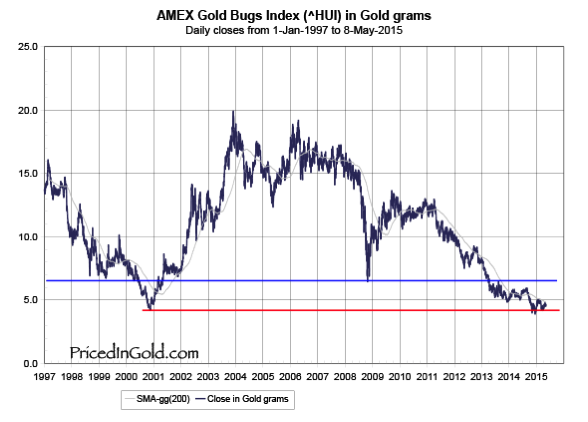
I think that a carefully selected portfolio of gold mining stocks, similar to the Gold Stock Analyst “GSA Top 10”, has great potential. It may take a few years to really take off, but I think the downside is limited, and the upside is excellent. The key is to put only very strong companies into the portfolio, as the bursting of the credit bubble created by the world’s central banks will disrupt financing plans and stress any company that does not have an iron-clad balance sheet – even it it is sitting on massive gold reserves.
I subscribe to the Gold Stock Analyst and use their Top 10 recommendations myself. I have followed their portfolio (priced in gold, of course) for many years, and recommend it as the best way I’ve seen to play the gold stock sector. If you are interested in trying their service, let me know and I’ll see if I can negotiate a deal for my subscribers.
