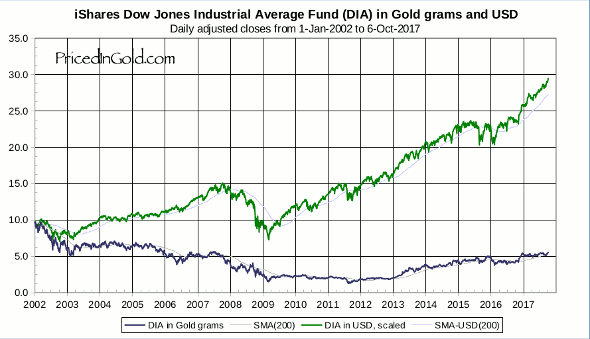
A subscriber recently sent me link to an article in the Wall Street Journal by Brett Arends titled "Why I Don't Trust Gold". This is the second part of a three part series, but as I write this, the third installment has not yet been published.

Although I agree with most of what he says, I would of course put it in different terms – for instance Mr. Arends says, "Gold is volatile. It's hard to value." and I would say, "The US Dollar is volatile. It's hard to value." Both statements are equivalent, depending only on whether you are valuing gold in terms of dollars, or dollars in terms of gold.

But the question is, which viewpoint will history record as the "right" one? On this score, I am completely convinced that he is wrong. There is NO example of ANY fiat money system EVER, in all of human history, that has not self-destructed. So in spite of his claim (in part one) that "It (gold) has a 'This time is different' story line", he is the one who is arguing that "it is different this time", not those who see gold as real money.

Of course the dollar can rally in value, even for decades at a time. But in the end, it will disappear like all the other attempts at a centrally planned and controlled currency, for the same reasons that centrally planned economies fail. When people are free to use anything they want for money, gold always seems to prevail. I don't think this time will be any different.

Filed under Video Podcast by  #

I think it's time we all switched to using gold as our unit of account, as the fiat currencies of the world continue to be consumed in a firestorm of inflationary "money" creation. Whether or not we hold actual physical gold (which we should, as our bedrock cash position) we should be seeking to own stuff that is rising in value in gold terms. The real problem is that the signals we get from investments priced in EUR, USD, JPY, etc. are being seriously distorted by the massive issuance of these currencies, resulting in investors continuing to hold them and even add to them, believing their value is rising when it is in fact falling.

US government bonds are a prime example – widely considered the safest investment in the world, and rising fairly steadily for years as interest rates drifted lower, they have in fact fallen to about half their 2002 value. Here are the details, using TLT, the 20 year T-Bond ETF as an example… In July of 2002, when the ETF was launched, you would have paid $82 per share for it. Over the years, you would have collected $29.71 in interest, and today you could sell each share for about $90. A nice, safe 46% return over 7.75 years, or 5% CAGR. But measured in gold grams, the picture is radically different. Each share cost 8.4 grams in 2002, and paid a total of 1.8 grams in interest over the years. Today, you could sell each share for about 2.5 grams – a 49% loss over the same 8 year period, for a -8.4% CAGR. I have created a chart of TLT in USD and gold, based on the "adjusted closing price" as calculated by Yahoo finance. Take a look at it to see what I'm talking about.
US Treasury Bonds in USD and Gold
And this is just the start of the collapse… as more dollars are created, bond buyers will begin to worry about the value of the dollars that will eventually be returned to them, and the interest they demand will skyrocket. This will create a double-whammy drop in bond prices as their value in dollars falls, and the value of each dollar falls as well.

Of course, just holding gold doesn't earn any profit (as measured in gold) but it doesn't lose value, either. There are plenty of investment strategies that have risen in gold value over that same period, but buying and holding most stock indices, bonds, real estate are not among them.

I'm working on a DVD series called "The Truth About Gold" that will detail some strategies for dramatically expanding your wealth, as measured in gold. I will be making a few copies available to early adopters on a pre-order basis; if you are interested, drop me an email at truth@pricedingold.com

I've recorded an expanded commentary on this topic as a podcast. You can download it or listen to it here:

Audio MP3

1

The news media is full of articles touting the Dow Jones Industrial Average close above 11,000 today. The chart below shows the index price in USD from 2006 to April of 2010.

In summary, prices had been rising since 2003, and began 2006 around the 11,000 level. They continued a relatively steady march to a new all-time high around 14,000 in the fall of 2007. The credit implosion of 2008 rapidly forced the index to a low around 6,500 in March of 2009, but since then it has been recovering strongly, returning to the 11,000 level today.

DJIA in USD from 1997-2010

This is the conventional story… but what is the truth?

The problem is that the Dow Index is measured in US Dollars, a highly volatile currency. As a result of the credit crisis, there has been tremendous creation of new money by the Federal Reserve to keep the monetary system afloat, causing a drastic reduction in value of the USD. In spite of this, there have been moments when the urgent need for US Dollars, to pay off debts and de-leverage, has forced the dollar's value higher, in a kind of "short squeeze", and occasionally problems in other countries have become so severe that the USD was seen as safe by comparison, increasing demand for it, and temporarily boosting it's value. (As Doug Casey recently observed, the US Dollar may be toilet paper, but at least it's three-ply!)

So when we remove the roller-coaster value of the USD from the picture, by pricing the Dow Jones Industrial Average in gold, what do we see?

DJIA 2006-2010 in Gold grams

From 2006 to fall of 2007, instead of rising 27% from 11,000 to 14,000 the index actually went sideways, hovering around 600 gold grams. Instead of falling 53%, from 14,000 to about 6,500, it actually fell 63%, from 600 grams to 220 grams. From this low it quickly rebounded to the 300 gram level, where it has been for the last year.

Although it's dollar value has returned to the level seen in 2006 and mid-2008, it's true value, measured in gold, is half of it's 2006 level, and three-quarters of it's 2008 level. Stock prices have not risen at all for the last year. The US Dollar, and most other fiat currencies, have simply fallen in value due to central bank manipulations, creating the appearance – but not the substance – of recovery and growth.

So don't be fooled… Keep an eye on what your investments are really doing, by pricing them in gold!

Here are my comments on the US home price data just released in April of 2010. Prices in dollars appear to be stabilizing… but what is really happening?

Filed under monetary universe by  #

Here is a news item I found interesting, followed by my restatement of the story, priced in gold. You can also view a chart of net worth.

Americans' net worth rises for third straight quarter

Friday, March 12, 2010

Stock gains boost Americans' net worth

Americans regained more of their shrunken wealth last quarter, mainly because of gains in stock portfolios. The Federal Reserve reported Thursday that household net worth rose 1.3 percent in the fourth quarter of 2009, to $54.2 trillion. Net worth rose 4.5 percent in the second quarter and 5.5 percent in the third. The value of stocks rose nearly 4 percent in the period, to $7.7 trillion. Higher home prices helped a bit: Real estate holdings edged up 0.2 percent.

Americans' net worth would have to rise 21 percent more to get back to its pre-recession peak of $65.9 trillion.

— Associated Press

===========================

Here's the story as priced in gold:

Americans' net worth falls for second quarter in a row

Friday, March 12, 2010

Currency losses gut Americans' net worth

Americans saw their wealth shrink again last quarter, mainly because of losses in the value of the dollar. The Federal Reserve reported Thursday that household net worth fell 8.7 percent in the fourth quarter of 2009, to 1,526 tonnes of gold. Net worth had risen 2.5 percent in the second quarter and fallen 1 percent in the third. Aside from the second quarter's uptick, net worth has been falling every period since the third quarter of 2007. Falling home prices caused a major hit: Real estate holdings dropped 9.6 percent to 467 tonnes. The value of stocks fell 6.3 percent in the period, to 217 tonnes of gold. Underlying all of these drops is the continuing debasement of the US Dollar, as bogus "bailouts", "stimulus plans" and other reckless deficit spending take their toll.

Americans' net worth would have to rise 227 percent to get back to its pre-recession peak of 5,000 tonnes of gold.

— Associated Press and PricedinGold.com

8

In a recent comment, Jules wrote "I once heard that a semester of college in 1920 cost the same number of gold oz as it would in 1990. Any truth to that?"

I've been wondering about that for some time now. My kids are young enough that I still have about 10 years before they will be looking at colleges, but it raises an interesting question: how much gold do I need to save now to cover their college costs in ten years?

After looking around for tuition numbers, I decided to focus on Yale University. They publish A Yale Book of Numbers and an update that contain all sorts of interesting data about Yale (including tuition costs) from 1701 to 1999. More recent data is available in news reports, press releases, and from Sallie Mae. I've compiled some of this data into the chart of Yale College Tuition, and I will update it annually going forward.

Although dollar costs for tuition, room, and board have risen tremendously, from about $700 per year in 1900 to $48,622 per year in 2009, their price in gold has only risen from 1,053 gold grams in 1900 to 1,726 gold grams in 2009. It's been a wild ride, though!

Before we continue, re-read that last paragraph carefully… in dollars, prices have risen to 70 times their starting price! SEVENTY TIMES! In gold, they are up 64% over a 109 year period. Interestingly, Yale tuition was almost exactly the same in the 2008-2009 school year (1,633 grams) as it was in the 1932-1933 school year (1,589 grams). It works out that 2008's annual tuition is just $30 more in the gold coins of 1932. In fact you'd get a couple of silver quarters and a silver dime back in change from your $10 eagle and $20 double eagle. This is in spite of a 44x increase in dollar prices, from $1,056 in 1932 to $46,000 in 2008.

Prices were quite stable until World War I, when they began to rise, peaking in the early 1930s at around 1,600 grams – not far from today's price! Although tuition prices in dollars were stable or rising very slowly, the collapse of the dollar in 1934, from about 1.5 grams to .88 grams, lowered tuitions as measured in gold dramatically.

They stayed low until after World War II, when they began to rise strongly, from about 1,000 grams to a peak of 3,441 grams in 1970. When Nixon gave up the defense of the dollar and closed the gold window, the dollar again collapsed, and although tuitions doubled in dollar terms, they fell in gold terms to a low of about 450 grams in 1980. As the dollar doubled in value from 1980 to 1999, and tuitions continued to rise in dollar terms as well, tuitions priced in gold rocketed to a new all-time high of 3,929 grams in 1999.

Since then, despite rising about 50% in dollar terms, the plunging value of the dollar has cut the cost of tuition to less than half of its old high.

As for the future? I don't own a crystal ball, so I can't be very specific… Still, it looks to me as though the current economic troubles could pull tuitions (priced in gold) lower from here. Technically, there seems to be good support at about 1,000 grams, and 500 would be a real bargain. It may take a few years to reach those levels, though. And 5 years after that, when I'm looking at college expenses for my kids? I suspect that the same 1.5 kg of gold that would cover most of a year today will still do the job then, even if the US Government is printing $1,000,000 bills and it takes a wad of them to buy a Big Mac.

Filed under Economy, gold prices by  #

I'm off to Vancouver BC for Agora's annual investment conference. This year, I will only be able to take in two days, July 22nd and 23rd. If you are attending, look for my trademark pith helmet! I'd love to talk with you about gold, the economy and how life is shaping up for you. Please look me up if you get a chance! You can also follow me on Twitter, @vollumc.

Filed under monetary universe by  #

Since I published Gold101 there have been some wonderful articles giving additional details on buying and storing physical gold.

The first, called "Gold coin shortage likely to become chronic" by Michael J. Kosares, outlines the reasons why gold bullion coins have been so hard to find at reasonable premiums, and why these forces will probably keep premiums high in the future as well. BTW, Michael's book, The ABCs of Gold Investing: How to Protect and Build Your Wealth With Gold is well worth reading if you are new to buying gold.

The second article was written by the editors of BIG GOLD at Casey Research and published in Dr. Steve Sjuggerud's excellent (and free) Daily Wealth email. Its title, "What You Need to Know About Storing Physical Gold" says it all.

Take advantage of gold's recent pullback (aka the US Dollar's recent strength) to add to your stock of cash that clanks – and keep your investments growing in their gold value!

Charles

PS: Dan Ferris, editor of Extreme Value, a newsletter I recommended to you in Gold101, scored big points with me in his weekly update today. Dan is a dyed-in-the-wool value investor, and his portfolio contains only excellent companies that are trading at great prices. But today he told his subscribers to sell several of his portfolio picks – including some long-time favorites and some very recent recommendations. Why did he do this? Because his honest opinion is that the stock market has further to fall, and having cash on hand will be key to taking advantage of the values that will be available in the future. He is keeping the strongest of his stocks, especially those he calls "World Dominators", and is buying some outstanding gold-related companies. This had to be a hard letter for him to write, but I think he's doing the right thing, and I applaud him for it. Follow his lead: take a hard look at what's in your portfolio, and don't be afraid to sell the weakest things in it, whether at a loss or a profit. Concentrate on strength and building your cash position for buying when things turn around.

1

Here are a few resources to help you move some of your savings into gold.

Remember that gold is a form of cash, not an investment. It doesn't grow in value, create new jobs, earn profits, or generate income for you. It is simply a currency that no government can counterfeit or debase. You should hold it as a way to reduce the volatility of your portfolio, or for long term saving. Don't imagine that owning gold will make you rich: If gold doubles in price due to massive creation of fiat currency, most of the other things you need to buy will eventually double in price as well. Gold can preserve your wealth, but not really grow it. For that you need real investments and prudent speculations.

Gold is the King of Cash!

From safest to riskiest:

1) Physical bullion coins and bars – your main risk is physical security. You need a safe place to keep it where it won't be stolen. Bank safe deposit boxes are great – unless the bank is closed. In-home safes and backyard burial are some of the alternatives. Pros: no counter-party risk, it's in your own control. Cons: hard to find at decent a price these days. Track the spot price at Kitco's 24 hr Live Gold. My favorite way to buy is through my local coin dealer, Beaverton Coin and Stamp. I suggest you look in the yellow pages and make the acquaintance of your local coin shop; they can be very helpful, and may be the best place to sell your gold when the time comes to convert your savings in to local currency. Another dealer I have used for years, always with very good results is Camino Coins.

2) Goldmoney.com – stores your gold (and silver) in insured third-party vaults in London or Zurich, and allow you to buy and sell via wire transfer, very quickly and easily. This is a great service, very easy to set up and use, perfect for savings. Pros: Very low markup, low storage fees, very safe storage, online access to funds. Cons: no way to get the gold in your hands except to sell the Goldmoney and use the funds to purchase physical gold. It is one of the best forms of "paper gold", but not quite the same as real gold in your pocket.

3) The Gold ETF, symbol "GLD": This is a stock that you can buy and sell in your brokerage account. The fund's managers try to make the value of each share be the same as 1/10 ounce of gold. There are also options on it , as with many stocks. Pros: a great tool for trading and speculating. Quick and easy to buy and sell. Cons: it is a stock, not really gold itself. Brokerages, dealers, stock exchanges, and many other counter-parties all have to perform in order for you to realize value from this security. Best used for shorter term trades in times when the markets are functioning well.

The next two categories are really speculations, not cash positions. Used prudently, they can increase the gold value of your investments. Used carelessly, they can destroy your savings. Proceed with caution:

4) Numismatic gold coins – these are really collectible antiques, with gold playing only a minor role in their value. They can be a great speculation, but like gold stocks they can rise and fall much faster than gold itself. There are some that are available for close to bullion prices; these are attractive because they offer a numismatic "kicker" to the gold value. Circulated common date US gold coins were in this category until recently; now they are hard to find at reasonable prices. On the other hand, almost all rare gold coins are now trading at premiums to gold that are very low compared to historical averages, and many offer good values; but they are still mostly "premium" and only a little "gold". Do not buy numismatics unless you know what you are doing or have expert assistance. My favorite expert is Van Simmons, president of David Hall Rare Coins.

5) Gold stocks: These are companies that explore for and mine gold and other metals, finance gold mining and receive royalties from gold production. Very risky! Many are just "holes in the ground surrounded by liars". Some are excellent speculations that can rise much faster than gold itself (and fall faster, as well). Some generate very nice income streams. You need good research to find the best plays and avoid the deathtraps. The dean of resource investing is Rick Rule of Global Resource Investments. Highly recommended. Newsletters that have performed well for me in the past (for many investments, not just gold stocks) include Brent Cook's Exploration Insights, Agora Financial's Options Hotline, Stansberry and Associates' Extreme Value, True Wealth and Short Report letters. Doug Casey has several excellent newsletters including Big Gold.

I hope this is helpful!

Charles

Filed under wages and salaries by  #