I have received several questions lately along the lines of, "What do these charts mean?", and "How do I interpret this chart?". This post is an attempt to answer these questions.
For the first time in quite a while, every asset class was lower this week.
The least weak asset was the long term treasury bond fund (TLT) which declined only 0.1%. The US election result, the impending "fiscal cliff", and massive tax hikes coming in only a few weeks, combined to drive the animal spirits into a frenzied flight to safety, with gold just barely edging out T-Bonds as the market's choicest safe haven. From a technical perspective, TLT is worth watching in the near future. This week it broke above its 200 day moving average on massive volume, and has stayed above for several days. If this support level holds, it could signal a return to its previous trading channel, with significant upside potential.
Filed under monetary universe by 
This was a good week for most investments, with all the currencies and bonds higher, all equities except gold stocks higher, and commodities mixed.
Bitcoin was the strongest currency, gaining 4.5% for the week, but this represents a recovery of less than half of last week's loss. The Japanese Yen was the best performing government currency, rising 1.9%, closely followed by the USD and EUR. Even the Canadian Dollar, the weakest of the bunch, rose 1.2%.
More on Market Update 2 Nov 2012 – Bitcoin recovers, Coffee makes new low
Filed under monetary universe by
All of the government currencies were strong again this week, led by the EUR, which rose 3.4%. Bitcoin (BTC) declined slightly, giving up 0.7% for the week to finish at 210.6 mg.
More on Market Update 19 Oct 2012 – Cotton, Nikkei up, Silver down
Filed under monetary universe by
Another great email this week:
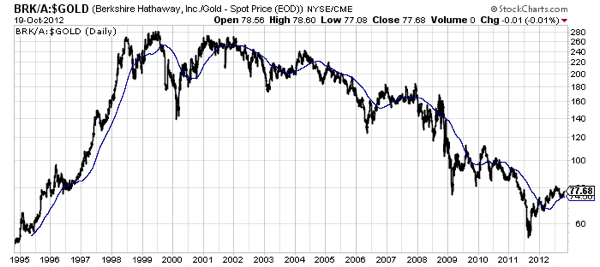
I often hear that Warren Buffet thinks gold is a lousy "investment" when compared to stocks. What I've never seen is a long-term comparison of gold versus BRK-A or other well-known "successful" funds.
Any chance of seeing a chart of BRK-A in gold?
I've been keeping that chart for years, but haven't updated it lately. You can check it anytime at stockcharts.com with the symbol "BRK/A:$GOLD". Basically, Berkshire did great until 1999, and has been lousy from then until about a year ago, falling 85% and giving up all of it's gains back to 1995. The last 12 months have been pretty good, but if you bought BRK-A anytime between 1996 and 2011, you are still underwater.
Here is a chart of BRK-A in ounces of gold:
Cheers,
Sir Charles
Filed under monetary universe by
I recently received the following email:
I have the option of taking a lump sum payment of approx. $90,000 now or waiting until I retire and receive a monthly payment of $500. I can expect to live at least 20 to 25 years from the time I can start receiving the monthly payment.If I take the money now, I will be taxed 20% and also get hit with another 10% penalty if I take it now.On paper it would seem that I would get more money by taking the monthly payments but since I won’t start those payments for another 10 to 15 years, I'm really worried about what my money will be worth 15 to 35 years from now.I’m thinking about taking the payment and investing in gold and silver but the investment would have to go up 50% just to make up the 30% I’d lose to taxes and penalty.I could roll it over to an IRA but I’m too close to retirement to take much risk.Any suggestions?
What a great question! Here is my answer:
I think you are on the right track… I'm not trained, registered, licensed or otherwise "qualified" to give this kind of advice, so all I can say is that if it were MY money, I would definitely take the cash now, while it's still worth something, and hold it in gold, or better yet, in investments that have a good chance of increasing their gold value, until I needed it for retirement.
A quick look at the Half Life of the Dollar curve will tell you why this is the way to go. Every 4 years, the USD loses half of it's purchasing power. So if you wait 8 years to get your money, you will be getting paid in dollars that have about 25% of the purchasing power of today's dollars. In 12 years, the dollars you're getting will be worth about half of that – they will only buy 1/8th of what dollars can buy today, and so on.
And this assumes that there is no catastrophic "fall off the monetary cliff" where the USD suddenly goes into a confidence nose-dive in which it either self-destructs, like the Zimbabwe dollar, or manages to avoid complete annihilation but becomes a secondary currency like the pound sterling, or a marginal currency like the Argentine Peso. Under these scenarios, things could be much worse than the curve suggests!
With the incredible levels of public and private debt that exist today, I don't think that significantly increasing the purchasing power of the USD is politically possible. To do so would require sending interest rates to the stratosphere – a policy that would bankrupt the US government and destroy the world's financial system. As Doug Casey says, the chances of that are between slim and none, and slim just left town.
Let's run some numbers to see how this plays out. If I take the cash now, pay the taxes and penalties, I get $63,000 of today's dollars, which will buy about 1,100 grams of gold:
Filed under monetary universe by
All of the government currencies were strong this week, with the CAD up 1.5%, JPY up 1.4%, and even the battered EUR showing a 0.5% gain. Bitcoin (BTC) however, took a beating, dropping 11% early in the week, but recovering some ground to finish the week down 4.6%. Remember my comments from last week: the BTC is a highly volatile young currency. Expect to see it mentioned often as one of the biggest winners or losers!
Filed under monetary universe by
Currencies were weak this week, with the EUR treading water up 0.1%, while the USD and CAD fell 0.4% and 0.6% respectively. The weakest of the bunch was the JPY, down 1.5%. This week I am starting to include coverage of Bitcoin (BTC). As you can see from the chart below, bitcoin has had a meteoric rise over during the last two years since its introduction, though this has been punctuated by sharp declines. This volatility is caused by the currency's youth: it is being adopted by thousands of new users each week, and this rising demand is pushing its value up. But any time there is a rumor of a theft or concern about a government crackdown, the value can tumble sharply. This week, BTC is the only currency to show much strength, and over the last month, and the last year, it outshines all other investment categories. Worth keeping an eye on! Learn more at bitcoin.org.
More on Market Update 5 Oct 2012 – Bitcoin, Coffee and Crude
Filed under monetary universe by
Anxiety over the massive coordinated money printing program continued this week, pushing the EUR and CHF to new all-time lows and the USD to the lowest level since February. For the week, though, the JPY dropped more than either the USD or EUR, losing 1.3% to close at 0.223 mg.
Filed under monetary universe by
Another great email just came in, asking for a chart of the US Federal Debt. I'm not sure what the US Debt numbers really mean… the data are so manipulated and massaged, and they leave out so much (state and local government debt, unfunded liabilities, and on and on)… but here is a stab at it.
This chart uses US Federal Debt data from US Federal Debt United States 1900-2016 – Federal State Local Data. The gold prices used for conversion are annual averages for 1900 to 2011, and for 2012 to 2016 they are estimates based on my Half-Life of the USD curve.
Over the last decade, the government has inflated away more than half of the peak federal debt. It is now back to late 1960s levels; if we continue to halve the debt every decade, it could be back to 1930s levels by the 2030s. Of course, by that time, gold will be over $45,000/oz, gas will be $120/gal, a first class stamp will cost $13 (if the USPS is still in business – not likely!), and a McDonald's Happy Meal will probably set you back $90.
I find it sort of refreshing to see that the debt is being reduced in real terms in spite of its phenomenal growth in nominal terms; but the economic implications of this "inflationary depression" are downright scary. The mis-allocations of capital caused by these policies will be horrendous, resulting in dramatically lower standards of living for the average family. I wonder if they can really keep it up for two more decades before people catch on to what's happening? We'll see!
Cheers,
Sir Charles
Editor@pricedingold.com

Filed under monetary universe by
