0

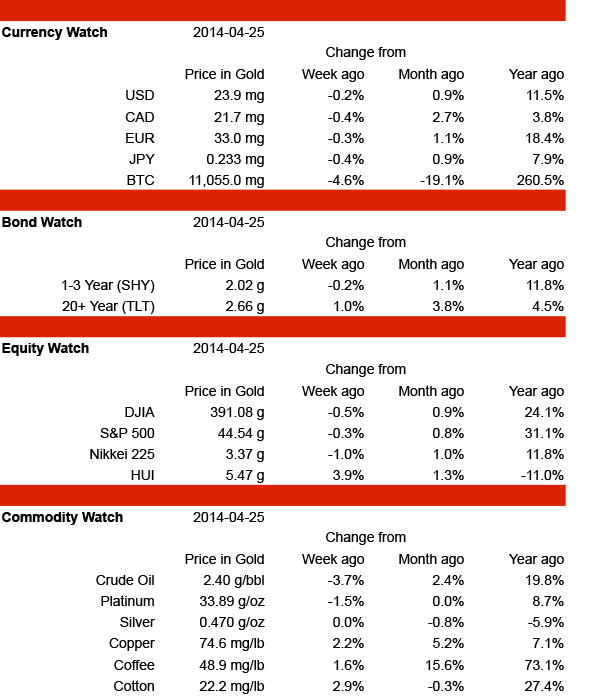
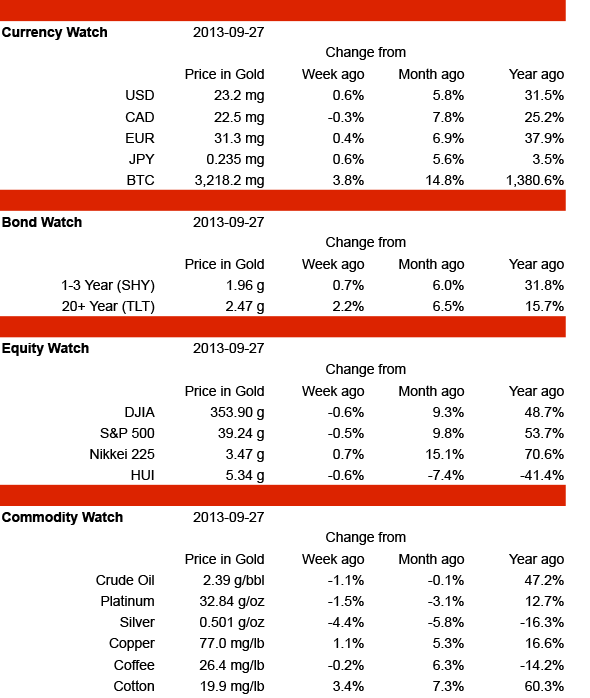
Markets were mixed this week, with currencies and bonds mostly higher while stocks and commodities were mostly lower. Bitcoin gained more than any other asset class, while silver lost the most ground.

The Canadian Dollar was the only declining currency, down 0.3% to 22.5 mg. The JPY and USD each rose 0.6%, with the dollar closing at 23.2 mg, now 52.7% above its half-life curve. Bitcoin, the free market internet currency, rose 3.8% to close at 3.2 g. Volume was just 28 kg, the lightest in over a year. See below for more comments on Bitcoin pricing.

Bonds moved higher, with the short term SHY rising 0.7%, slightly better than the underlying USD, while the long term TLT added 2.2%. During the week, TLT pushed right up to, but failed to overcome resistance at 2.52g, falling back  to close at 2.47 g.

Stocks were mostly lower, with the Nikkei, up 0.7%, the only gainer. The S&P 500 was down 0.5%, while the Dow Jones Industrials and the HUI Gold Bugs Index each fell 0.6%.  The Dow settled just below its 355 g support level, but the HUI ended at the lowest level since August 8th, and only 2.6% above it's 22 year low of 5.205 g set three months ago.

Commodities were mixed, with Cotton gaining 3.4% and Copper rising 1.1% while the rest of the complex fell. Silver led the losers, falling 4.4%, while Crude oil was 1.1% lower.  Platinum was down 1.5% to 32.8 g, now 5.6% above gold parity.

Silver gave up all of the prior week's gains and then some, ending at a new low for the month of 0.501 g/oz.

Silver

I have received many questions about the my use of Mt. Gox USD prices as the basis of my BTC chart. Because the USD represents about 72% of all BTC trading (with the EUR next at 9% and CNY third at 7%) and because gold is usually quoted in USD, using a USD price for bitcoins makes sense.

Of the exchanges reporting to bitcoincharts.com, 64% of the USD volume goes through Mt Gox, with bitstamp making up 30%, and btc-e handling 6%. So at this point, Mt Gox is still by far the largest single exchange.

Prices on Mt Gox are a bit higher than on the other USD exchanges. This may be due to greater difficulty in getting USD funds out of the Mt Gox system; if moving funds out was fast and easy, a large profit could be had buying BTC on bitstamp and selling them on Mt Gox, which would rapidly push the prices back into line. But speculators using FX trading to increase their BTC holdings, rather than seeking a profit in USD, probably find the tight spreads and higher volumes on Mt Gox make it the best platform for their needs.

Bitcoincharts has no way to track offline person to person transactions, and as these offer a great deal more privacy than the large online exchanges, they may be getting a significant amount of volume that goes unreported.

Even though Mt Gox prices are a bit higher than bitstamp and btc-e, I think that the overall shape of the chart would be little different if I used their prices instead. I will continue to monitor this situation and if Mt Gox marketshare shrinks, or the price gap widens, I may look at rebuilding the chart based on a volume weighted average of all the active exchanges. (If I took that approach today, the closing BTC price would be shown as 3.11 g rather than 3.22 g.)

Table of prices in gold for week ending 27-Sep-2013

2

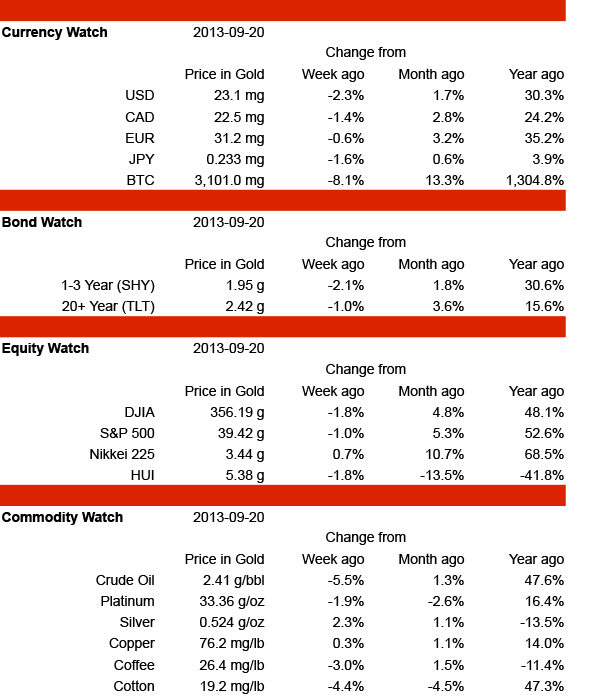
Markets were mostly lower this week. Bitcoin and crude oil fell more than any other asset classes, while silver was the biggest winner. Copper and the Nikkei stocks were the only other assets in the black.

Government-issued currencies all declined, led by the USD, which closed at 23.1 mg, down 2.3%, now 51.2% above its half-life curve. Bitcoin, the free market internet currency, fell 8.1% to close at 3.1 g. Volume was very light at 32 kg.

Bonds lost ground this week, with the short term SHY falling 2.1%, slightly better than the underlying USD, while the long term TLT dropped 1.0% to close at 2.42 g. Last week TLT closed above its 200 day moving average; this week it continued the rally, but failed to overcome resistance at 2.52g, falling back to close just above the 200 DMA.

Stocks were mostly lower, with the Dow Jones Industrials and the HUI Gold Bugs Index each falling 1.8%.  The S&P 500 was down 1.0%, while the Nikkei Index was up 0.7%. In the previous week, the Dow Jones Industrials bounced smartly off of the 61.8% Fibonacci support level, and this week they seem to be finding support at around 355 g (about 11.5 ozt).

DJIA

Commodities were mixed, with silver gaining 2.3% to close at 0.524 g/oz, and Copper rising 0.3% while the rest of the complex fell. Crude oil was the biggest loser, falling 5.5% to 2.4 g per barrel.  Cotton declined 4.4% while Platinum was down 1.9% to 33.4 g, now 7.2% above gold parity.

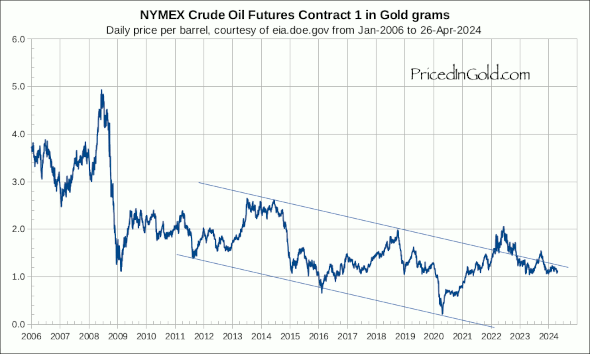
Crude's drop gave up most of the gains for the month, and left it at long term support.

Crude Oil

Table of prices in gold for week ending 20-Sep-2013

0

Markets were mostly lower this week. Bitcoin gained more than any other asset class, while gold stocks showed the greatest losses. Silver and long term bonds were the only other assets in the black.

Government-issued currencies all declined, with the Euro leading the way, falling 1.7% and the Canadian dollar losing 1.3%. The USD closed at 22.3 mg, down 1.2%, now 44.9% above its half-life curve. Bitcoin, the free market internet currency, rose 12.5% to close at 3 g. Volume remained light at 58 kg.

Bonds were mixed again this week, with the short term SHY falling 1.2% alongside the underlying USD, while the long term TLT gained 0.4% to close at 2.36 g. Although rising slightly, TLT is still trading below its 200 day moving average.

Stocks were all lower, this time led by the HUI Gold Bugs Index, which fell 8.1% to 5.66 g.  The S&P 500 was down 3.0%, while the Dow Jones Industrials gave up 2.6% to close at 330.3 g. The Dow is still above its 200 day moving average, and is sitting 61.8% above its low of last November.

DJIA

Commodities also declined, with the sole exception of silver, which gained 1.2% to close at 0.527 g/oz. Copper, down 4.6%, and Platinum, down 2.8%, were the worst performing commodities. Crude oil was little changed, falling 0.1% to 2.4 g per barrel.

Table of prices in gold for week ending 30-Aug-2013

0

This was a mixed week for everything but government issued currencies, which were all lower. Bitcoin gained more than any other asset class, while cotton and coffee showed the greatest losses. Precious metals gained slightly, and gold stocks were unchanged. This assessment is based on the London PM fix; if the New York close was used instead, most prices given would be about 1.5% lower, and every asset class but silver and Bitcoin would be in the red for the week.

Government-issued currencies declined, with the Canadian Dollar leading the way, falling 2.2% and the  Japanese Yen losing 1.1%. The USD closed at 22.6 mg, down 0.6%, now 46.2% above its half-life curve. Bitcoin, the free market internet currency, rose 8.4% to close at 2.7 g. Volume increased to 61 kg, but was still very light.

Bonds were mixed, with the short term SHY falling 0.7% alongside the underlying USD, while the long term TLT was little changed, gaining 0.3% to close at 2.35 g.  Note again that based on the NY close for gold, TLT was actually down 1.2%.

TLT

Most stocks were lower, again led by the Dow Jones Industrials, which lost 1.1%, while the S&P 500 was almost unchanged, giving up only 0.1%. The HUI Gold Bugs Index was also unchanged at 6.2 g. Japan's Nikkei Index fell 1% to close at 3.14 g.

Commodities were mixed, with platinum and silver rising while the rest of the complex declined. Cotton and coffee were the weakest asset classes this week, giving up 10.3% and 6.7% respectively. Crude oil pulled back 1.6% while copper lost 0.9%.

Based on the London PM fixings, silver rose 0.4% to close at 0.521 g/oz, while platinum gained 0.3% to close at 34.7 g/oz, now 11.6% above gold parity. However, using New York closing prices, platinum fell 1.2% for the week, closing at 34.2 g. Silver's price was the same at London fixing and at NY close.

On Monday, silver reached 0.529 g, just above its multi-year resistance level of 0.525 g, but quickly declined to 0.518 and closed at 0.521, failing this first test. If history is any guide, it may take several more attempts before we find out if this resistance will hold, pushing silver lower. I think this is a strong possibility. For more details on why, check out Keith Weiner's excellent commentary over at the Monetary Metals blog.

Silver

Table of prices in gold for week ending 23-Aug-2013

0

Currency, bond, and equity markets (other than gold stocks) were lower this week, while commodities were mixed. Crude oil's fall accelerated, while silver rocketed higher. But the most important price action this week was in the collapse of the long bond.

Government-issued currencies were sharply lower, with the Japanese Yen leading the way, falling 5.8%. The USD closed at 22.7 mg, down 4.4%, now 46.6% above its half-life curve. Bitcoin, the free market internet currency, rose 1.6% to close at 2.49 g.

Bonds were sharply lower, with the short term SHY falling 4.5% with the underlying USD, while the long term TLT was crushed, losing 7.9% to close at 2.35 g. This is a decisive breakdown for the long bonds, punching down through long term support, and closing below its 200 day moving average. We may see a retest of the old support around 2.55 to see if it has now become resistance. 

TLT

Most stocks were lower, led by the Dow Jones Industrials, which lost 6.5%, while the S&P 500 dropped 6.4%. The HUI Gold Bugs Index was the only equity index in the black, roaring ahead 7.9% to close at 6.2 g after hitting a high of 6.47 g on Thursday. It is looking more and more like the bottom is in on mining stocks, but there is still resistance overhead at 6.8 to 7.0 g.

Commodities were mostly lower, but silver and cotton continued their climbs of the prior week.  Coffee was the weakest in the complex, giving up 6.3%. Crude pulled back 3.1% while copper lost 2.9%.

The biggest commodity winner this week was Silver, which rose 7.5% to 0.519 g/oz, just below resistance at 0.525 g. 

Silver

Platinum lost 2.3% to close at 34.6 g/oz, now 11.3% above gold parity.

Table of prices in gold for week ending 16-Aug-2013

0

I just received a call on the Priced in Gold Hotline asking for clarification about ounces and grams of gold and other precious metals.

First off, precious metals prices are most commonly quoted in US Dollars per troy ounce. We all haves a pretty good idea of what a dollar is, but a troy ounce is something we don't often see in any other context. It isn't the same as the ounce used in US household measures or scales… those ounces (known formally as avoirdupois ounces) weigh 28.3495 grams, and come 16 to the pound. Troy ounces weigh about 31.1035 grams, and come 12 to the troy pound. (Note that the word "ounce" comes from the latin for one-twelfth.)

Measuring things smaller than an ounce becomes very cumbersome in the troy system, where each ounce is divided into 20 pennyweights, and each pennyweight is divided into 24 grains.

And there are many other kinds of ounces, as well: Apothecaries' ounce, Maria Theresa ounce, Spanish ounce, Roman ounce, Dutch metric ounce, and Chinese metric ounce, to list just a few. Each has a different weight. There is even an International metric ounce of 25 grams, for which 20 ounces make a metric pound of 500 grams.

On the other hand, the gram is an international unit of scientific measure, with little room for confusion.

Grams also have the advantage, being metric, of being useful for a wide range of weights. Using prefixes, we can talk about micrograms (useful for describing the value of a single Japanese Yen or Chilean Peso; milligrams, useful for giving the value of most stocks, or a single USD or EUR; grams for the value of a bitcoin, a high priced stock like GOOG or AAPL or a stock index like the S&P 500 or the Dow Jones Industrial Average; kilograms for the value of houses, college tuitions or BRK-A; or tonnes, kilotonnes, or even megatonnes for the net worth of millionaires and billionaires, or regional, national or worldwide econometric statistics.

To convert the price of gold in any currency (for instance  today's London PM fix of $1,369.25 USD per troy ounce) into the price of that currency in gold grams, just divide 31.1034768 by the gold price (for instance 31.1034768 / 1369.25 = 0.02272 grams/USD). I often find it more convenient to express this in milligrams, so I multiply by 1000 to get 22.72 mg per USD.

I have also considered the possibilitiy of using the original definition of the US Dollar as my unit of weight instead of the gram. The Coinage Act of 1792 defined the dollar as 1.7 grams of gold or 27 grams of silver, but these weights are for "standard" purity of about .900 fineness. This gives about 20.5 USD per troy ounce of pure gold.

So another way to state the price of a USD today would be to take 20.5 USD/oz (then) and divide it by 1369.25 USD/oz (now) to get 0.01497 – so one dollar today would be worth about 1.5 cents in 1792 dollars. And you can convert any USD price today to its 1792 price by just multiplying by 0.01497. For instance, today's DJIA close of $15,081.47 becomes $255.795 (not so different from the 352.763 g price you'll find on Priced in Gold.)

This has a lot of appeal, as it makes clear how far the USD has fallen in purchasing power, but I worry that it confuses things by introducing another kind of dollar, and takes focus away from the point that we should be leaving all fiat currencies behind us, and moving into the clarity of pricing purely in gold.

There is no need for each country to define its own weights and measures for gold money. We have the gram and we have gold. That is all we need!

Filed under monetary universe by  #

0

On Friday afternoon I was interviewed on Power Trading Radio's weekend edition with John O'Donnell. If you aren't familiar with this show, it's part of the Online Trading Academy, which offers a wide range of courses to improve the abilities of investors and traders, covering stocks, futures, forex and options.

We discussed how pricing in gold can help an investor see through the distortions caused by central bank operations, the long term outlook for the dollar, housing prices, stocks, and much more. Watch it here.

If you are interested in adding to your skills as an investor or trader, consider some of their course offerings. Everything they teach, from technical analysis to fundamental analysis, from trade planning to wealth management, can be given an added boost by understanding and using gold pricing.

Filed under Stocks, US Dollar, Video Podcast by  #

1

The markets were mixed this week, with bonds and currencies little changed, stocks generally lower, and commodities mostly higher. The HUI gold stocks moved up with the commodity complex; crude oil was the only commodity to close down for the week.

Currencies were mixed, with the Euro and Japanese Yen gaining 0.8% and 1.7% respectively, while. the Canadian Dollar and Bitcoin fell 0.8% and 1.8%.  Bitcoin trading was very quiet, with an average 29 kg changing hands each day on Mt Gox. 

The USD was unchanged at 23.8 mg, but rose to 52.9% above its half-life curve, as the curve continues to fall every week. The "expected price"  of the USD is now 15.5 mg, which is equivalent to a gold price of $2,001 – up from $1,995 the previous week. At some point, I expect the USD to "revert to the mean", falling rapidly to the 15.5 mg level and probably overshooting considerably to the downside. I recommend taking advantage of the strong USD now to purchase precious metals, select mining stocks, and other real assets – before the mean reversion crash.

USD Half-Life

Bonds were quiet, with the short term SHY unchanged, in sync with the underlying USD, while the long term TLT added 0.7% to close at 2.55 g. Once again, TLT is staying very near its support and resistance levels.

Most stocks were lower, led by the Nikkei, which retreated 4.3%, giving up much of last week's gain, and making the Nikkei this week's worst performing asset class overall. The Dow Jones Industrials lost 1.5%, while the S&P 500 dropped 1%. The HUI Gold Bugs Index was the only equity index to gain ground, rising 2.3% to close at 5.7 g. Last week's comments on playing the gold stocks still apply; we are waiting for confirmation of the market's next move.

With the exception of crude oil, commodities were all sharply higher.  Crude pulled back 0.9%, pausing for breath after last week's 3.8% surge. Copper just kept on rising, however, adding another 4.5% to last week's 3.7% gain. Over the last few months, copper has been in a rising channel, making a series of higher lows and higher highs, but it remains well below its long term average price of 213 mg.

Copper

Silver and cotton were almost as strong, gaining 4.4% each. Silver bounced smartly off its lows to close at 0.483 g/oz, about where it was trading a month ago. Platinum added 3.9% to close at 35.5 g/oz, now 14% above gold parity.

Table of prices in gold for week ending 9-Aug-2013

0

Most markets moved higher this week, led by Bitcoin and the Nikkei stocks. The exceptions were silver, coffee, and especially gold stocks, which fell more than any other investment class.

Currencies all rose, led by Bitcoin, up 10.9%, and the Japanese Yen, which gained 3.6%. The USD rose 1.7% to 23.8 mg, putting it 52.3% above its half-life curve. The CAD was the laggard, gaining back the 1.6% it lost in the prior week. Bitcoin trading was a bit more active, with an average 67 kg worth of BTC changing hands each day – about double the daily volume for the previous week.

Bonds were up, with the short term SHY gaining 1.7%, in sync with the underlying USD, while the long term TLT was almost unchanged, adding 0.4% to close at 2.53 g. TLT continues to dither about, staying right at its support and resistance levels. A break one way or the other should be coming soon.

Long Term Treasuries

Most stocks were higher, led by the Nikkei, up 6.1%, more than making up for last week's drop. The S&P 500 added 2.7%, exactly reversing last week's fall. The HUI Gold Bugs Index was the only equity class to lose ground, declining 6.7% to close at 5.58 g. This leaves the crystal ball quite cloudy for the gold stocks until they break out above 6.25 g or fall below 5.2 g. If we do get an extended period of sideways trading it could be an opportunity to acquire some longer dated call options at reasonable prices, and if we get a breakdown below 5.2 g heading for a retest of the old low at 4.2 g, check out the possibility of selling some puts on high quality miners you'd like to own.

Silver

Commodities were mostly higher, with the exception of coffee and silver. Silver closed the week down 1.2% at 0.462 g/oz, the lowest price seen since 25-Aug-2010, and approaching support at 0.45 g. Coffee fell 1.7%, and is now 16.4% above its all-time low set last December. Crude oil and copper showed the most strength, gaining 3.8% and 3.7% respectively. Note that 2.4 g has been a critical level for crude oil for years, acting as support in 2007, and resistance many times from 2009 through 2011. In june, crude broke out above 2.4 g and reached 2.65 g in early July. This week, crude retested the 2.4 level as support, and bounced smartly off of it to close at 2.54 g. Platinum recouped the 2.2% it lost in the prior week to close at 34.1 g/oz, now 9.7% above gold parity.

Table of prices in gold for week ending 2-Aug-2013

3

Most markets were sharply lower this week; the exceptions were bitcoin, gold stocks, and silver. Most significant was the rise in the HUI gold stock index, which climbed all the way to 6.1 g before closing at 6.0 g, 15% above its recent low.

The government-issued currencies were all weaker, led by the USD, which declined another 2.6% to 23.4 mg, leaving it 49.4% above its half-life curve. The CAD and EUR were the least weak, losing 1.6% and 1.8% respectively. Bitcoin stabilized this week, climbing 2.1% to close at 2.25 g. Trading was very quiet, with only 30 kg worth of BTC changing hands – a far cry from the 535 kg we saw during the Cyprus banking crisis last April.

Bonds were lower, with the short term SHY losing 2.6%, in sync with the underlying USD, while the long term TLT fell 3.6% to close at 2.53 g, just below support at 2.55 g. This is a crucial point for TLT, as it sits both at a long-term support/resistance level, and at the bottom of its upward trending channel.

Long Term Treasuries

Most stocks declined again, with the Nikkei down 5.5% and the S&P 500 off 2.7%. The HUI Gold Bugs Index was the only equity advancer, adding another 3.6% to close at 5.98 g. This extends the rally to resistance between 6 and 6.25. If the HUI can clear this hurdle, the next stop is long term resistance at 6.8.

HUI Gold Stocks Chart

Silver was the only commodity that didn't fall this week, adding 0.4% to close at 0.47 g/oz, little changed. Crude oil led the decliners, falling 5.7%, followed by cotton and copper, each down 3.9%. Platinum dropped 2.2% to close at 33.4 g/oz, now 7.3% above gold parity.

Table of prices in gold for week ending 26-Jul-2013